
TDEE Calculator – Maintenance Calories for Lifters
Estimate daily maintenance calories, then compare an illustrative cut or bulk. Your weight trend is the calibration step the equation cannot provide.
Your numbers, your next step.
Slide or enter a value to update the result.
Estimated maintenance calories
2,711kcal/day
Resting estimate: 1,749 kcal/day. Adult planning estimates; calibrate against your weight trend.
| Goal | Illustrative calories/day |
|---|---|
| Cut · 15% below | 2,304 |
| Maintain | 2,711 |
| Bulk · 10% above | 2,982 |
Free, no signup. Inputs stay in your browser; they are not sent to Trainer.
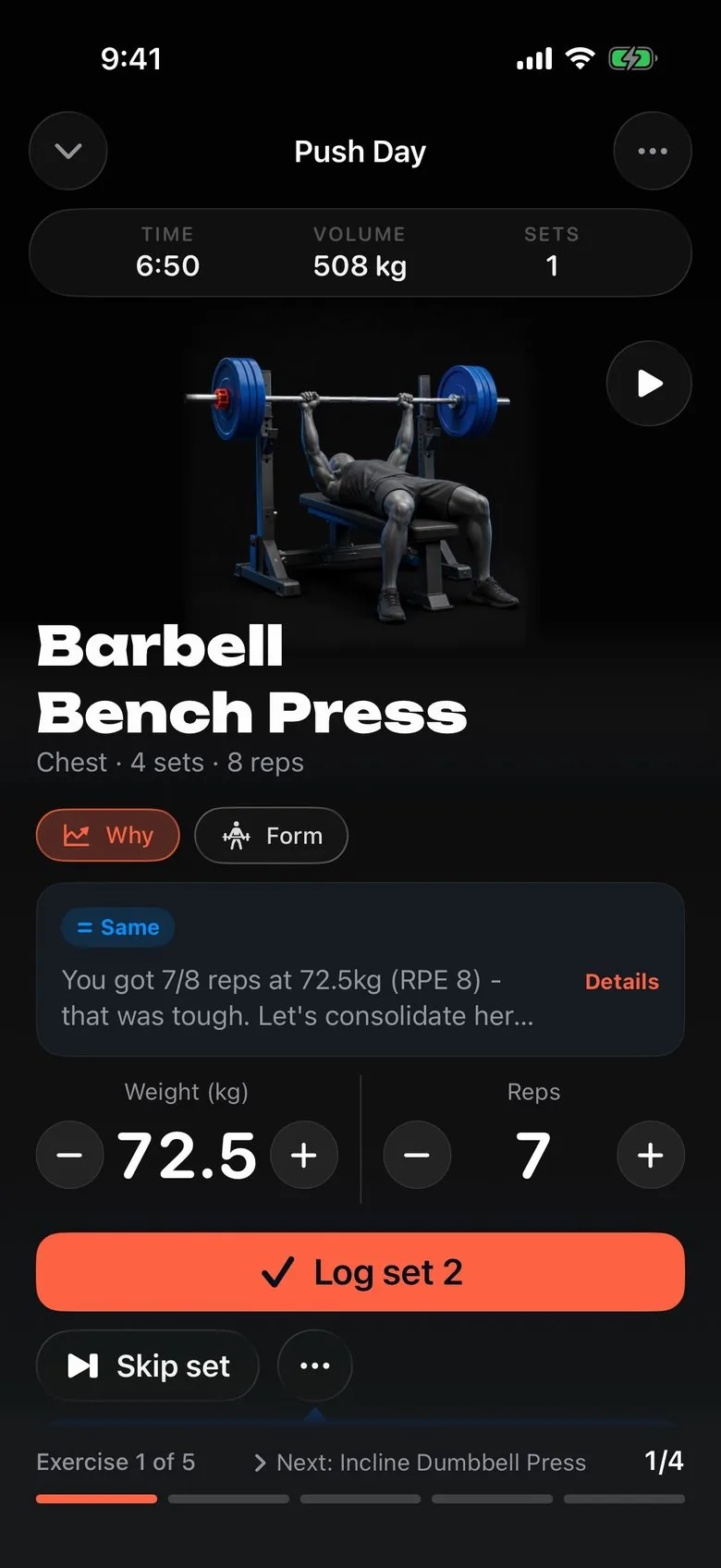
Calls your next set.
Every set arrives pre-filled with the weight and reps to hit next, and the reason why.
Get the appWhat TDEE means
Total daily energy expenditure is the energy your body uses across a day. It includes resting needs, food digestion, exercise, and ordinary movement. Your daily calorie intake relative to that expenditure influences the direction of your body-weight trend over time. The number changes with your routine; it is not a permanent property stored in your body.
This calculator estimates resting expenditure first, then multiplies it by an activity factor. Enter body weight, height, age, and the relevant equation coefficient. The historical model uses male and female coefficients. They describe the equation's original structure and cannot represent every person's physiology. This tool is for adult planning, not for children, pregnancy, clinical nutrition, or a personalized medical diet.
The Mifflin-St Jeor formula
The commonly used rounded formula is ten times weight in kg, plus 6.25 times height in cm, minus five times age in years. Add five for the male coefficient, or subtract 161 for the female coefficient. TDEE is that resting estimate multiplied by the chosen activity factor. Imperial inputs are converted to kg and cm before the calculation.
The original Mifflin-St Jeor research is the basis for the resting estimate; the activity categories are practical multipliers, not a measured metabolic test. A male-coefficient example at 80 kg, 175 cm, and age thirty produces about 1,749 resting calories. With a 1.55 multiplier, the maintenance estimate is about 2,711 calories per day. The rounded display should not make that estimate feel exact.
| Goal in this tool | Calculation | How to interpret it |
|---|---|---|
| Maintenance | Resting estimate × activity factor | Starting hypothesis |
| Cut | Estimated maintenance × 0.85 | Illustrative moderate deficit |
| Bulk | Estimated maintenance × 1.10 | Illustrative small surplus |
Choose activity from your whole day
Three gym sessions do not automatically make a mostly seated week very active. Consider walking, commuting, physical work, sport, and training together. Someone lifting twice while working on their feet can expend more energy than someone lifting four times and sitting for the rest of each day. Pick a plausible category, then let observations improve it.
Do not add every calorie reported by a watch on top of an activity multiplier that already includes your workouts. That risks counting the same activity twice. Consistency is more valuable than finding the perfect category label. If your schedule changes substantially, recalculate and reassess rather than carrying an old target into a new routine.
Calibrate maintenance with real observations
Use a consistent intake and measure body weight under similar conditions over several weeks. Daily weight can change because of food volume, hydration, carbohydrate intake, and normal biological variation. Compare weekly averages rather than reacting to a single morning. If the average stays roughly stable, your observed intake is a better maintenance clue than a calculator result alone.
If the trend does not match your goal, make a modest adjustment and observe again. Keep training performance, energy, sleep, and appetite in the decision. The guide to lean bulk calories explains a surplus without pretending that all gained weight is muscle. The guide to cutting without losing muscle explains why an aggressive deficit can make training harder.
Move from calories to meals
Once you have a reasonable calorie starting point, use the macro calculator to divide it into protein, fat, and carbohydrate. The protein calculator offers a simple adult training range. Those are planning aids, not rules that turn ordinary meals into a daily exam.
You do not need to hit the displayed calorie number to the last unit. Food labels, serving estimates, and actual expenditure all contain uncertainty. Aim for a repeatable pattern you can review. If food tracking becomes distressing, or your situation includes a medical condition, get individual support rather than trying to solve the problem with more decimal places.
Frequently asked questions
How accurate is a TDEE calculator?
It is a starting estimate. Activity categories and individual resting expenditure introduce uncertainty. Use several weeks of intake and weight-trend observations to calibrate the result.
Should I eat back Apple Watch exercise calories?
Avoid automatically adding them when your activity multiplier already includes training. Review the overall intake and weight trend rather than treating a watch estimate as an exact allowance.
Why are there male and female coefficients?
Mifflin-St Jeor was fitted with sex-specific terms. The selector exposes that historical model; it is not a statement about identity and does not capture every individual situation.
Keep building your plan
- Macro Calculator for Lifting – Bulk, Cut or Recomp
- Protein Calculator – Grams per Day to Build Muscle
- Calories Burned Lifting Weights Calculator: MET Estimate
- Creatine Calculator: Loading and Maintenance
- Lean Bulk: Calories, Macros and Rate of Gain
- How to Cut Without Losing Muscle
- Compare nutrition trackers for your calorie and protein plan
- Choose a repeatable exercise and check the setup