
1 Rep Max Calculator – One Rep Max Calculator & Chart
Use this 1 rep max calculator to estimate your one rep max from a recent hard set. Compare Epley, Brzycki, and Lombardi estimates, then use the percentage chart to plan training loads.
Your numbers, your next step.
Slide or enter a value to update the result.
Estimated one-rep max · Epley
93.3kg
- Brzycki
- 90 kg
- Lombardi
- 94 kg
A prediction, not a tested maximum. Estimates are most useful at 2–10 reps near failure.
Training loads from your estimate
Each row is a percentage of the Epley estimate.
| % of Epley e1RM | Share of your max | Weight |
|---|---|---|
| 100% | 93.3 kg | |
| 95% | 88.7 kg | |
| 90% | 84 kg | |
| 85% | 79.3 kg | |
| 80% | 74.7 kg | |
| 75% | 70 kg | |
| 70% | 65.3 kg | |
| 65% | 60.7 kg | |
| 60% | 56 kg | |
| 50% | 46.7 kg |
Free, no signup. Inputs stay in your browser; they are not sent to Trainer.
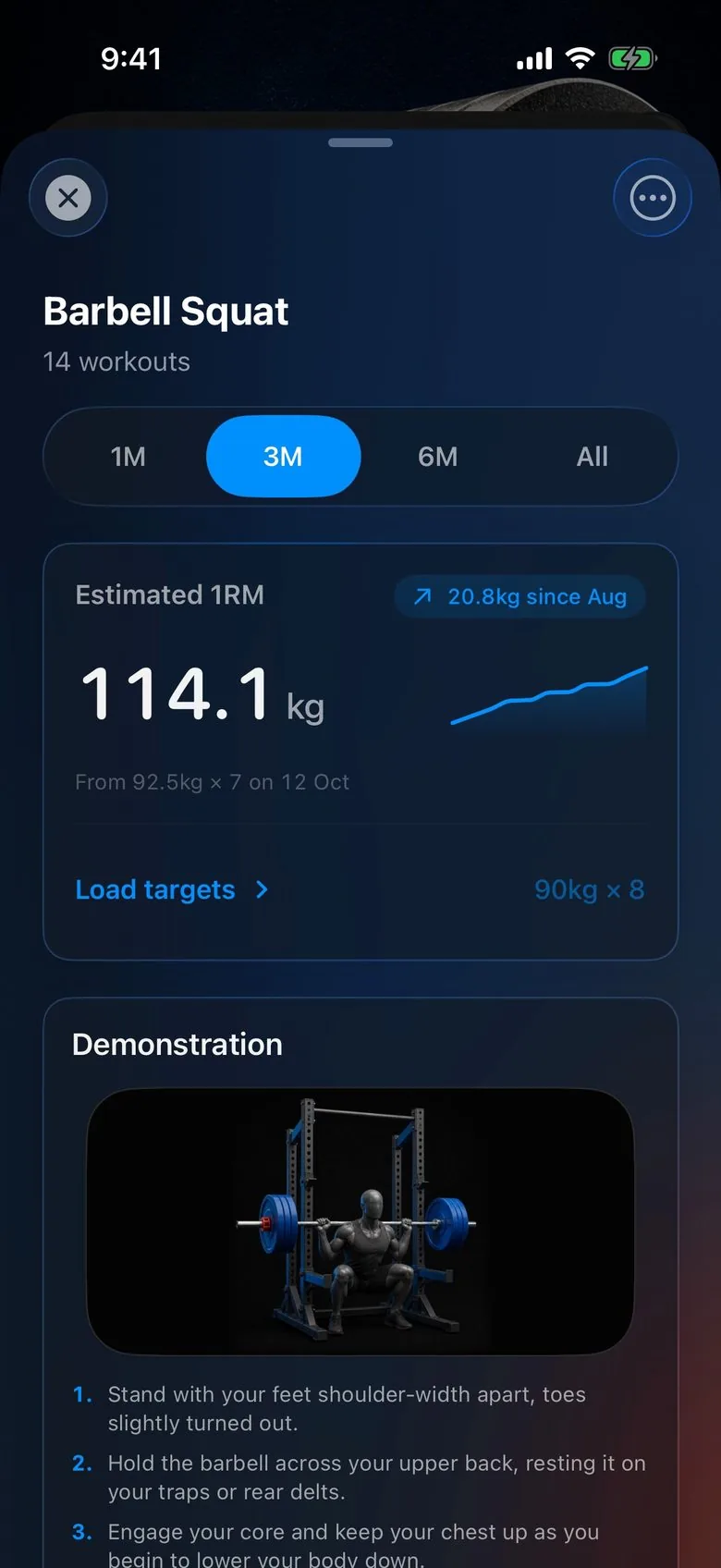
Every lift, tracked.
Trainer works out your estimated max from the sets you log, for every lift, and shows how far it has moved.
Get the appHow to use the one-rep max calculator
Enter the total weight lifted and the number of completed repetitions. For a barbell, include the bar and both sides. For a dumbbell movement, use the weight of one dumbbell and keep that convention in your log. A set of five with 80 kg means 80 kg for every repetition, not 80 kg multiplied by five. Choose kg or lb before reading the percentage chart.
Pick a recent set with controlled technique and consistent range of motion. A hard set of two to ten repetitions is usually more useful here than an easy warm-up or a long set stopped by breathlessness. The calculator accepts up to twenty reps so you can explore the formulas, but high-rep predictions deserve much less confidence. It cannot see whether your last rep used a different technique.
The three formulas
Epley estimates maximum load as weight multiplied by one plus reps divided by thirty. Brzycki uses weight multiplied by thirty-six, divided by thirty-seven minus reps. Lombardi multiplies weight by reps raised to the power of 0.10. These are separate models of the relationship between repetitions and load. Agreement between them is useful context, not proof that you can safely lift the result.
For a single completed repetition, this tool returns the lifted weight for all three models. It does not inflate an actual single into a larger prediction. If you deliberately left several reps in reserve, use the RPE calculator instead and read its assumptions. A comfortable set of five is not the same evidence as a genuine five-rep maximum.
| Set | Epley estimate | Brzycki estimate | Lombardi estimate |
|---|---|---|---|
| 80 kg × 5 | 93.3 kg | 90.0 kg | 94.0 kg |
| 100 kg × 3 | 110.0 kg | 105.9 kg | 111.6 kg |
| 60 kg × 10 | 80.0 kg | 80.0 kg | 75.5 kg |
Turn the percentage chart into a session
The chart applies each listed percentage to the Epley estimate. It is a loading reference, not a prescription for a number of reps. Eighty percent does not guarantee eight reps, because endurance, exercise selection, fatigue, and experience all affect the relationship. Round to a load you can actually build, then judge the first working set before deciding whether to increase.
If your estimated bench maximum is around 93 kg, seventy percent is about 65 kg. That can be a useful starting point for a moderate session, but you still need a rep target and an effort target. Use the plate calculator to load the nearest achievable weight. You should not add a mismatched plate because a decimal result looks precise.
Track a trend instead of chasing a number
Compare sets performed on the same exercise under similar conditions. Keep grip, depth, pause, equipment, and rep range reasonably consistent. A paused bench and a fast touch-and-go bench are different tests. Save the original weight and repetitions alongside the estimate so future you can tell what actually changed.
A single bad day does not establish lost strength. Look at several sessions. More reps at the same weight, better control at the same reps, or the same performance with less effort can all be worthwhile progress. The guide to calculating one-rep max explains those comparisons in more detail. The guide to breaking a strength plateau helps when several comparable sessions stop moving.
When a tested maximum makes sense
A tested maximum is an actual performance, while this calculator estimates one. Beginners usually have plenty to learn from normal working sets before testing a true limit. If you eventually test, use suitable safeties, a competent spotter where appropriate, and progressive warm-ups. Stop if technique breaks down or pain changes the movement.
Do not use the prediction as an obligation to attempt that weight. A calculator cannot assess readiness, spot a loose rack setup, or judge a missed rep. Its useful job is smaller: translate a good training set into a consistent reference and help you choose the next sensible training load.
Frequently asked questions
Which one-rep max formula should I use?
Use one formula consistently for trends. Epley is the main result here; Brzycki and Lombardi show how much a different model changes the estimate. None is universally accurate for every exercise or lifter.
Does the calculator work in pounds?
Yes. Switching units converts the entered load. The formulas work in either kg or lb when the input and output use the same unit.
Should I lift my estimated maximum?
The estimate is not a readiness test. Use it as a training reference, and assess technique, fatigue, safeties, and spotting before considering a heavy single.
Keep building your plan
- RPE Calculator & Chart – RPE/RIR to % of 1RM
- Plate Calculator – What Plates to Load on the Bar
- Workout Log Template: Printable and CSV Journal
- One Rep Max Chart: How to Calculate Your 1RM
- Progressive Overload: The Beginner's Guide
- Compare apps that track and progress your next set
- Choose a repeatable exercise and check the setup