
Plate Calculator – What Plates to Load on the Bar
Enter a total barbell target and the bar weight. See the plate pairs for each side and any shortfall when standard plates cannot make the exact load.
Your numbers, your next step.
Slide or enter a value to update the result.
Achievable barbell load
100kg
Load the same plates on each side. Collars are excluded; available pairs are assumed unlimited.
| Plate on each side | Count per side |
|---|---|
| 25 kg | 1 |
| 15 kg | 1 |
Free, no signup. Inputs stay in your browser; they are not sent to Trainer.
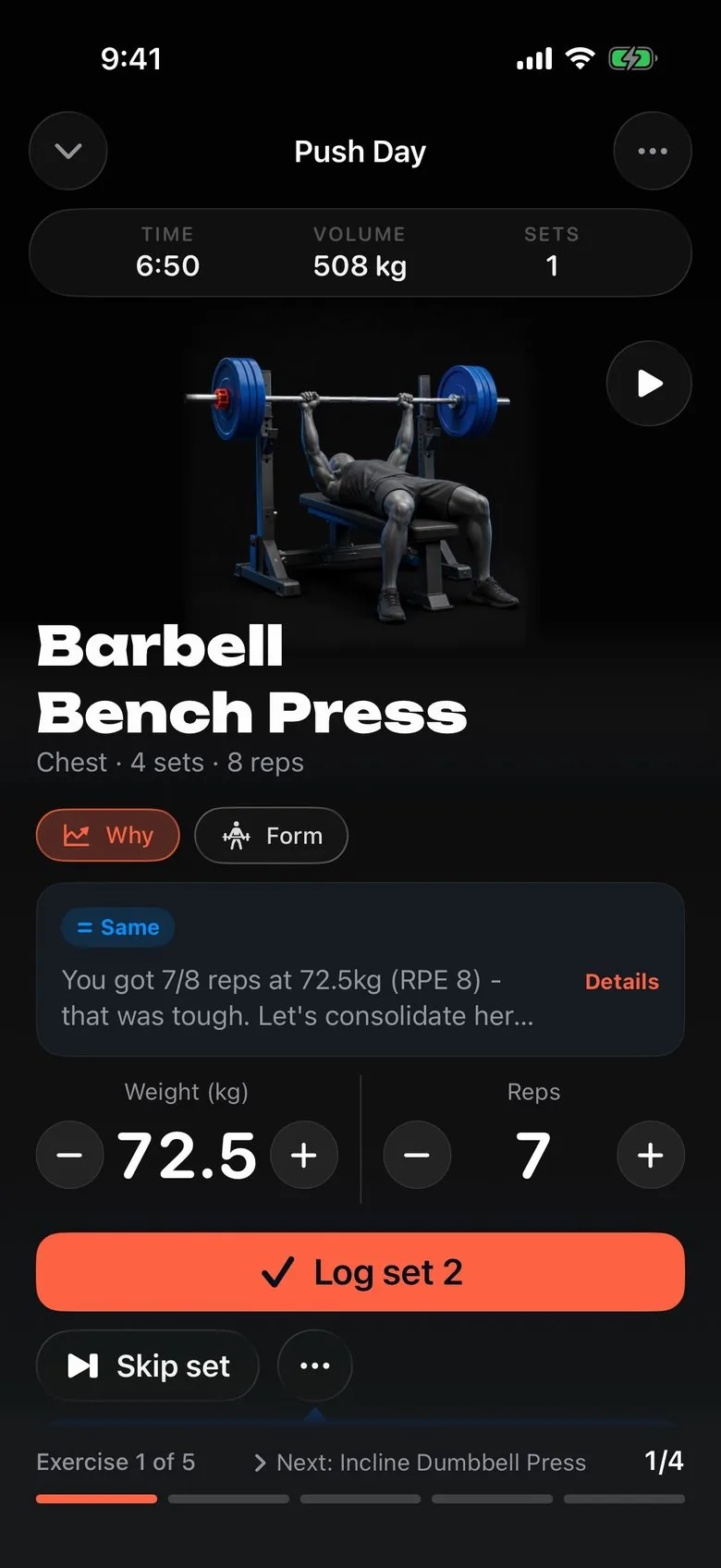
Calls your next set.
Every set arrives pre-filled with the weight and reps to hit next, and the reason why.
Get the appLoad the total weight, not the weight on one side
Enter the weight you want on the complete barbell, including the bar. Then enter the bar's own weight. A 100 kg target on a 20 kg bar leaves 80 kg for plates, or 40 kg per side. The tool displays the same plate combination on the left and right so you can check the setup before lifting.
Read the label on your gym's bar rather than assuming every bar is 20 kg or 45 lb. Training bars, women's bars, specialty bars, and fixed bars can have different weights. Collars are excluded from this calculator. If your collars have meaningful mass and exact loading matters, account for it separately and keep your logging convention consistent.
The plate-loading formula
Plate weight per side equals target total minus bar weight, divided by two. The tool tries standard denominations from largest to smallest and returns a load at or below your target. For kg, the available plates are 25, 20, 15, 10, 5, 2.5, and 1.25. For lb, they are 45, 35, 25, 10, 5, and 2.5. It assumes unlimited matching pairs of those plates.
The chart is not an inventory of your gym. If a denomination is unavailable, use another balanced combination or choose a different achievable load. A weight switch converts your existing target and bar, but changes the available plate set to the selected system. A 45 lb plate is about 20.4 kg; it is not identical to a 20 kg plate.
| Target | Bar | Plates on each side |
|---|---|---|
| 100 kg | 20 kg | 20 kg + 20 kg |
| 60 kg | 20 kg | 20 kg |
| 225 lb | 45 lb | 45 lb + 45 lb |
Understand an unachievable target
The smallest listed kg pair adds 2.5 kg to the bar. The smallest listed lb pair adds 5 lb. If your target falls between those increments, the result shows the nearest lower load produced by the standard set and names the remaining shortfall. It does not claim an exact match or recommend uneven loading to reach a decimal target.
For example, a 101 kg target on a 20 kg bar is not possible with the listed kg plates. The tool loads 100 kg and shows a 1 kg shortfall. Smaller matching change plates could close that gap, but they are not included in this plate set. Use the actual loaded weight in your training record.
Use the visual as a final check
The larger plates sit nearer the center in the diagram. Read the numbers as well as the colors; the drawing is a simplified visual aid and does not encode every real plate's diameter. Before you lift, inspect both sides yourself. Count each side, secure collars where suitable, and check the rack or platform setup.
The calculator does not assess a bar's capacity, rack safety, or whether you can lift the requested weight. Large inputs can create many plates in the diagram, which scrolls inside its own area. That is a loading calculation, not a recommendation to assemble an unusually heavy bar.
Connect loading to a training plan
Use the one-rep max calculator for a rough reference from a recent hard set, then choose a practical working load. The warm-up calculator turns a working weight into an example ramp. Neither replaces your judgment about effort or technique during the session.
The guide to progressive overload explains why adding the smallest available pair can be enough. The guide to increasing your bench press covers the case where a large jump makes the next set too difficult. Change plates can be useful, but completing another controlled rep can also be progress.
Keep the log consistent
Record bar plus plates as your barbell weight every time. If you use a different bar, note it. A consistent log makes your next session easier to interpret and prevents apparent progress that is actually a changed loading convention. The calculator's best use is straightforward: fewer plate-counting mistakes, balanced sides, and a clear record of what you actually lifted.
Frequently asked questions
Does this include the bar?
Yes. Enter the complete target and the actual bar weight. Plate weight is the difference split equally between both sides. Collars are excluded.
What if my gym is missing a plate size?
The tool assumes unlimited standard pairs. Use a different balanced combination or a lower achievable target when your actual inventory differs.
Why is the result below my target?
The standard plate set cannot produce every number. The calculator rounds down and shows the shortfall instead of pretending the load is exact.