
DOTS & Wilks Calculator – Powerlifting Score
Compare a squat, bench, and deadlift total across body weights using DOTS and original Wilks. The tool converts all loads to kg before applying either formula.
Your numbers, your next step.
Slide or enter a value to update the result.
DOTS score
275.82
Original Wilks: 273.08. Three-lift total in kg; no age adjustment. DOTS formula body weight: 80 kg. Wilks formula body weight: 80 kg. Bounds clamp as documented.
| Formula | Points |
|---|---|
| DOTS | 275.82 |
| Original Wilks (not Wilks-2) | 273.08 |
Free, no signup. Inputs stay in your browser; they are not sent to Trainer.
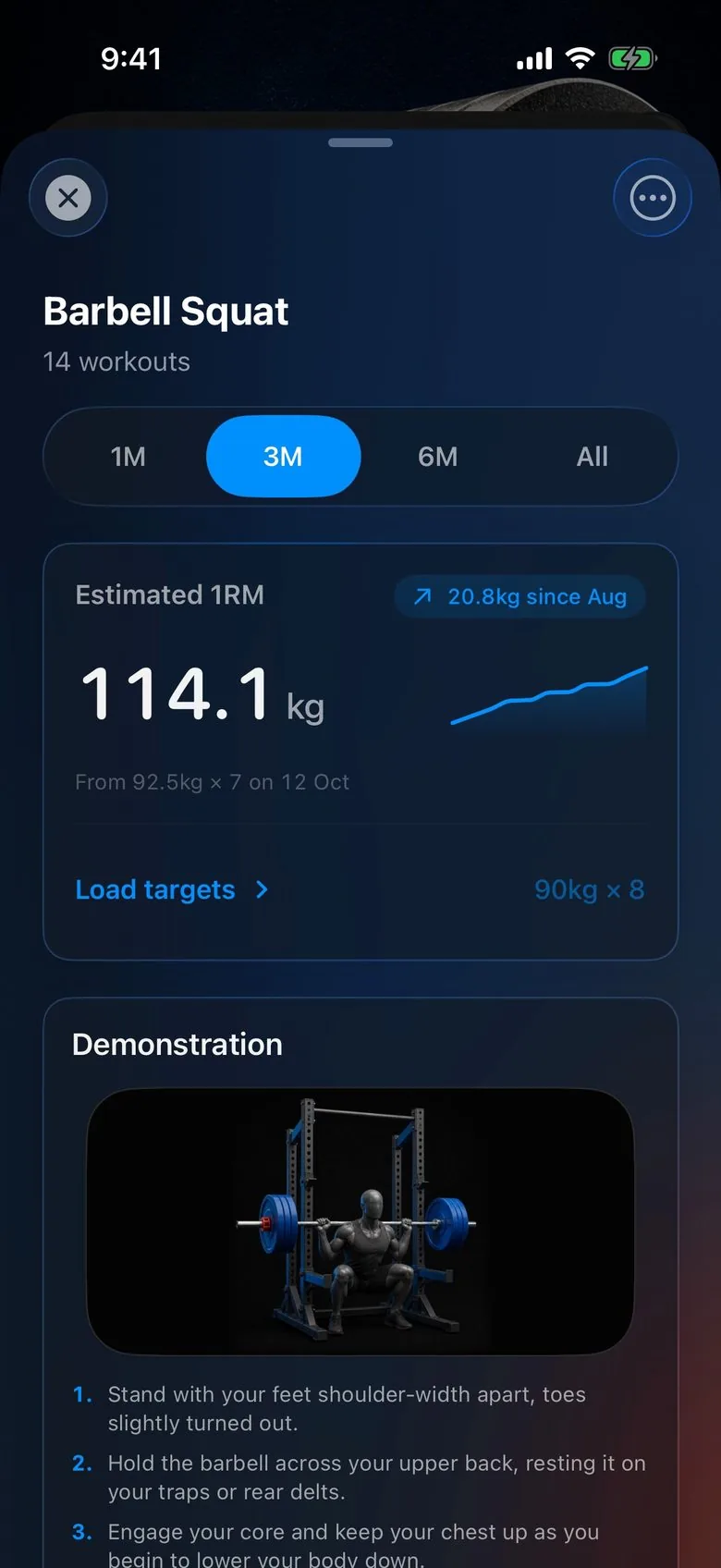
Every lift, tracked.
Trainer works out your estimated max from the sets you log, for every lift, and shows how far it has moved.
Get the appWhat a DOTS score measures
DOTS converts a powerlifting total into a bodyweight-adjusted point score. Enter the sum of your squat, bench press, and deadlift, plus your body weight. Use the same weight unit for both fields. A 400 kg total is the sum of all three best lifts, not the load of one exercise multiplied by three.
The score is designed to make different body weights easier to compare. It is not a complete measure of athletic ability, health, or training quality. Equipment rules, judging standards, and event format still matter. A gym total and a judged competition total can look identical as numbers while representing different performances.
DOTS and original Wilks are separate formulas
Each formula multiplies the total in kg by a coefficient derived from body weight in kg. DOTS uses a fourth-degree polynomial; original Wilks uses a fifth-degree polynomial. Both use sex-specific coefficient sets. This page reports original Wilks, not Wilks-2, Wilks2020, or IPF GL points. Those names should not be used interchangeably.
The calculation is total multiplied by five hundred, divided by the relevant bodyweight polynomial. The coefficients and boundary behavior were checked against OpenPowerlifting's public DOTS implementation and original Wilks implementation. Select the intended coefficient set and keep the formula name beside any score you record.
| Formula | Male bodyweight bounds | Female bodyweight bounds |
|---|---|---|
| DOTS | 40–210 kg | 40–150 kg |
| Original Wilks | 40–201.9 kg | 26.51–154.53 kg |
Why the tool shows formula body weight
At an input outside a formula's published bounds, this implementation clamps the bodyweight used in the coefficient to the nearest bound. The actual three-lift total is still used. Both adjusted bodyweight values are displayed so the behavior is visible. The page does not quietly extrapolate a polynomial far beyond its intended range.
For example, a male-coefficient body weight above 210 kg uses 210 kg in the DOTS polynomial. Original Wilks reaches its upper boundary sooner. If the formulas use different effective body weights, comparing their raw point values becomes even less intuitive. Scores from different formulas are already on different scales; a larger number in one formula does not imply better performance.
Use a coherent total
For a competition comparison, use lifts from the same meet and the official weigh-in body weight. For a personal training reference, label a gym total clearly and use performances obtained under reasonably similar conditions. Combining lifetime bests across years can be interesting, but it is not the same thing as a total you demonstrated in one event.
This calculator has no age adjustment, equipment adjustment, or event-specific correction. It cannot tell whether a federation accepts a particular formula. Check the actual event rules before using a score for qualification or awards. The tool supplies the arithmetic, not an official competition result.
Compare progress with more than one number
Track the total, body weight, and individual lifts alongside the score. A higher score can come from a larger total, a bodyweight change, or both. The detail matters when deciding what to train next. If the total improves while bench remains flat, a single combined score can conceal a useful coaching question.
Use the strength standards calculator for simple lift-to-bodyweight ratios, with its clearly labeled editorial estimates. The one-rep max calculator helps summarize working sets, although estimates should not replace tested competition attempts in an official total.
Put the score back into a training context
The guide to breaking a strength plateau helps identify whether technique, fatigue, or progression needs attention. The guide to RPE and RIR helps you describe effort in normal sessions. Those details explain your training better than a points score alone. Use DOTS or Wilks for the comparison they were built to support, then return to the specific lift and next sensible training decision.
Frequently asked questions
Is this Wilks-2 or Wilks2020?
No. The second output is original Wilks. Formula names are shown explicitly because their scores and coefficients are different.
Why does my bodyweight get clamped?
The coefficient implementations use documented bounds to avoid inappropriate extrapolation. The adjusted bodyweight for each formula is shown beside the result.
Can I enter pounds?
Yes. Body weight and three-lift total are converted to kg before the coefficient is calculated. The output is a point score, not kg or lb.