
Protein Calculator – Grams per Day to Build Muscle
Get a protein planning range for healthy exercising adults. Compare a simple daily target with portions spread across the meals you already eat.
Your numbers, your next step.
Slide or enter a value to update the result.
Protein planning range
112–160g/day
An illustrative 1.6 g/kg target is 128 g/day, or about 32 g across each of 4 meals. For healthy exercising adults.
| Protein factor | Grams/day |
|---|---|
| 1.4 g/kg | 112 |
| 1.6 g/kg | 128 |
| 1.8 g/kg | 144 |
| 2 g/kg | 160 |
Free, no signup. Inputs stay in your browser; they are not sent to Trainer.
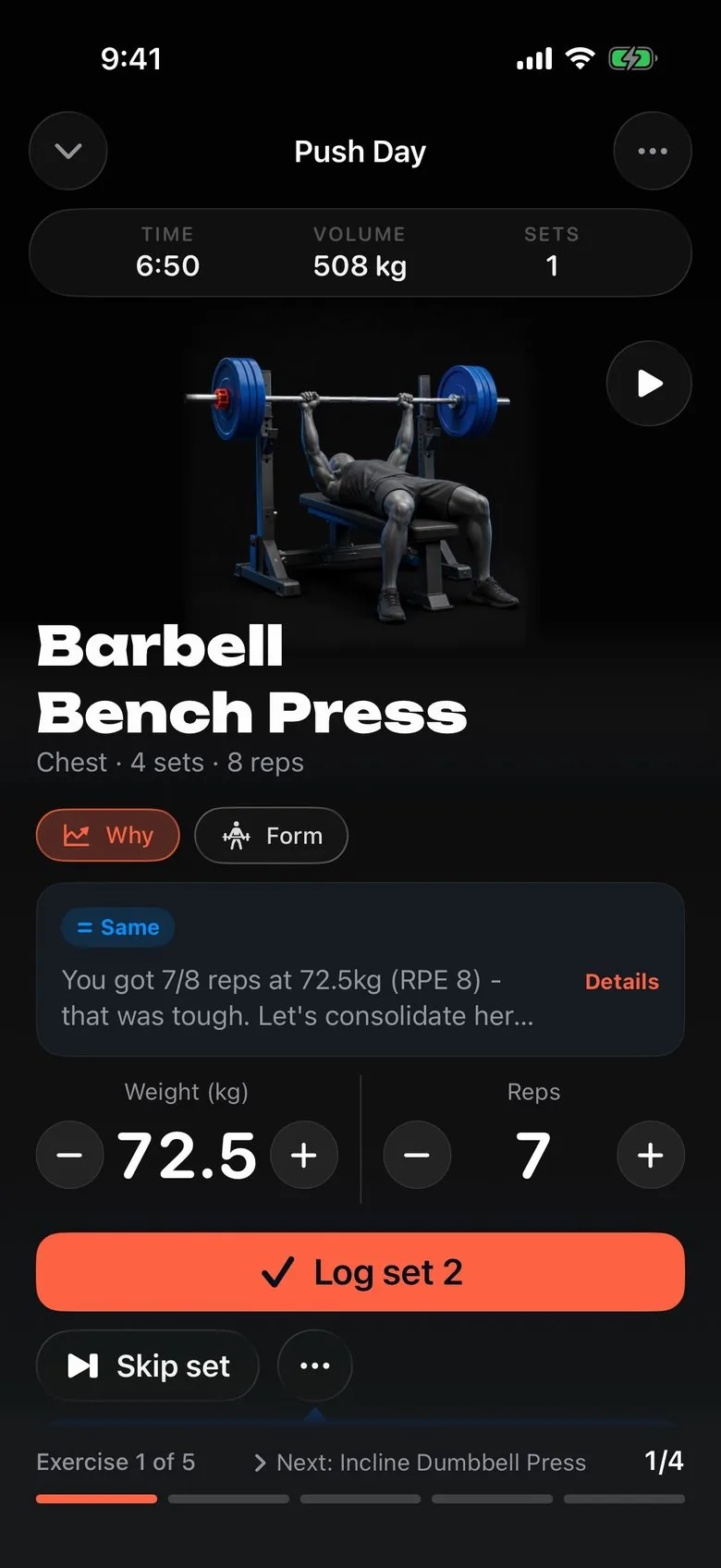
Calls your next set.
Every set arrives pre-filled with the weight and reps to hit next, and the reason why.
Get the appCalculate a useful daily protein range
Enter your body weight and choose how many meals or eating occasions you normally have. The tool returns a range from 1.4 to 2.0 grams per kilogram of body weight per day. It also shows a middle planning example at 1.6 g/kg, divided across your selected number of meals. That middle number is a convenient illustration, not a universal optimal dose.
The ISSN protein position stand describes 1.4–2.0 g/kg/day as sufficient for most exercising individuals. This calculator uses that published range for healthy adults. It does not assess medical needs, pregnancy, or whether your current diet is adequate in every respect. A clinician-set protein target should take priority when relevant.
The formula and unit conversion
Protein grams per day equal body weight in kilograms multiplied by the selected grams-per-kilogram factor. When you enter pounds, the calculator first multiplies by 0.45359237 to convert to kilograms. Do not multiply a g/kg factor by pounds directly. A 176 lb person is roughly 80 kg, so the range is similar to the 80 kg example below, not twice as large.
| Body weight | 1.4 g/kg | 1.6 g/kg example | 2.0 g/kg |
|---|---|---|---|
| 60 kg | 84 g | 96 g | 120 g |
| 80 kg | 112 g | 128 g | 160 g |
| 100 kg | 140 g | 160 g | 200 g |
Use a recent representative body weight rather than recalculating after every small daily change. Hydration and food volume can move the scale without changing your protein needs meaningfully. If weight changes substantially over a longer period, review the target alongside the rest of your diet.
Turn grams into ordinary food
Choose foods you enjoy and can afford. Dairy, eggs, fish, meat, tofu, tempeh, beans, and other foods can contribute. Read serving labels instead of assuming every scoop, pot, or fillet contains the same amount. A practical day starts with a protein source in your normal meals, not with a requirement to drink a shake after every set.
If you eat four times per day and the example target is 128 g, the tool displays roughly 32 g per occasion. That division helps you visualize a day. It does not require every meal to be identical, and a larger dinner does not invalidate the plan. Treat meal-sized numbers as preparation cues rather than hard thresholds that separate useful and useless food.
Protein works inside an energy budget
Meeting protein does not replace an adequate overall intake. If your goal is to gain muscle, you still need a workable training plan and enough energy to recover. If your goal is fat loss, protein can help structure meals, but an extreme calorie deficit can make performance and adherence harder. The guide to protein for muscle growth explains the relationship without promising a guaranteed rate of progress.
Use the macro calculator when you want protein, fat, and carbohydrate to fit an overall target. Use the TDEE calculator when you need an initial maintenance estimate. The guide to cutting without losing muscle covers training and food decisions during a deficit. None of those tools can measure your personal recovery on its own.
Supplements are optional conveniences
A protein powder can be convenient when ordinary meals leave a gap. It does not have to be the foundation of your diet. Compare the label, taste, tolerance, and cost per serving. If normal food gets you to a reasonable daily intake, buying another supplement is not a necessary next step.
Start by observing a few typical days. If your usual intake is far below the planning range, improve one repeatable meal first. That small change is easier to maintain than rebuilding your entire diet overnight. Review how the pattern fits appetite, schedule, and training. The most useful target is one you can reach through a stable routine without making food tracking consume the rest of your day.
Frequently asked questions
Do I need a protein shake?
No. A shake is an optional convenience. Normal meals can supply your protein; a supplement is useful only if it helps fill a practical gap.
Is the meal target a strict requirement?
No. It divides an illustrative daily target across your eating occasions to help you plan portions. Your meals do not have to contain exactly equal amounts.
Should I use this if I have kidney disease?
Use your clinician or dietitian’s individual advice. This general calculator is for healthy exercising adults and cannot set a medical nutrition target.
Keep building your plan
- Macro Calculator for Lifting – Bulk, Cut or Recomp
- TDEE Calculator – Maintenance Calories for Lifters
- Creatine Calculator: Loading and Maintenance
- Lean Body Mass Calculator: Boer, James and Hume
- How Much Protein to Build Muscle?
- How to Cut Without Losing Muscle
- Compare nutrition trackers for your calorie and protein plan
- Choose a repeatable exercise and check the setup