
Workout Generator: Build a Weekly Lifting Plan
Build a weekly lifting plan with exercises, sets, reps, rest, and a progression rule. Choose your goal, experience, equipment, training days, and session budget to get a starting template instantly.
Your week, ready to train.
Choose your goal, equipment, and time to update the plan.
Your weekly split · rule-based
Three-day full body
3 beginner sessions/week for muscle growth, using a full gym, with a 45-minute session budget. Your plan uses about 32–34 min per session, including warm-up. See exercises below, followed by your progression rule and time assumptions.
Monday · Full body A
About 32 min, including warm-up
- Goblet squat · 2×8–12 · 90s rest
- Machine chest press · 2×8–12 · 90s rest
- Seated cable row · 2×8–12 · 90s rest
- Dumbbell Romanian deadlift · 2×8–12 · 90s rest
- Dead bug · 2×10–15/side · 60s rest
- Seated dumbbell shoulder press · 2×8–12 · 90s rest
Wednesday · Full body B
About 32 min, including warm-up
- Dumbbell Romanian deadlift · 2×8–12 · 90s rest
- Seated dumbbell shoulder press · 2×8–12 · 90s rest
- Lat pulldown · 2×8–12 · 90s rest
- Goblet squat · 2×8–12 · 90s rest
- Dead bug · 2×10–15/side · 60s rest
- Machine chest press · 2×8–12 · 90s rest
Friday · Full body C
About 34 min, including warm-up
- Dumbbell reverse lunge · 2×8–12/side · 90s rest
- Machine chest press · 2×8–12 · 90s rest
- Seated cable row · 2×8–12 · 90s rest
- Dumbbell Romanian deadlift · 2×8–12 · 90s rest
- Dead bug · 2×10–15/side · 60s rest
- Seated dumbbell shoulder press · 2×8–12 · 90s rest
| Day | Exercise | Sets | Reps | Rest | Session estimate |
|---|---|---|---|---|---|
| Monday · Full body A | Goblet squat | 2 | 8–12 | 90s | 32 min, including warm-up |
| Machine chest press | 2 | 8–12 | 90s | ||
| Seated cable row | 2 | 8–12 | 90s | ||
| Dumbbell Romanian deadlift | 2 | 8–12 | 90s | ||
| Dead bug | 2 | 10–15/side | 60s | ||
| Seated dumbbell shoulder press | 2 | 8–12 | 90s | ||
| Wednesday · Full body B | Dumbbell Romanian deadlift | 2 | 8–12 | 90s | 32 min, including warm-up |
| Seated dumbbell shoulder press | 2 | 8–12 | 90s | ||
| Lat pulldown | 2 | 8–12 | 90s | ||
| Goblet squat | 2 | 8–12 | 90s | ||
| Dead bug | 2 | 10–15/side | 60s | ||
| Machine chest press | 2 | 8–12 | 90s | ||
| Friday · Full body C | Dumbbell reverse lunge | 2 | 8–12/side | 90s | 34 min, including warm-up |
| Machine chest press | 2 | 8–12 | 90s | ||
| Seated cable row | 2 | 8–12 | 90s | ||
| Dumbbell Romanian deadlift | 2 | 8–12 | 90s | ||
| Dead bug | 2 | 10–15/side | 60s | ||
| Seated dumbbell shoulder press | 2 | 8–12 | 90s |
Your progression rule
Keep about 3 clean reps in reserve. Add reps within the listed range before adding load. After one successful exposure at the top of every working set, add the smallest available load increment and restart at the low end. For timed holds, add 5 seconds per side up to 40 seconds before choosing a harder variation. If reps or technique fall short, repeat or reduce the load; the calendar never earns an increase.
How the time budget works
Time estimates include 5 minutes of preparation (7 in a gym), 3 seconds per rep at the top of the range, both sides of unilateral exercises, every between-set rest, and 60-second transitions (90 in a gym). Short budgets reduce sets and optional exercises. Extra warm-up, queues, or longer rest can extend the session; the budget is a ceiling for this model, not a promise to fill every minute.
Use this week
The named weekdays are an example. Keep the listed order and recovery days when moving sessions to your calendar. Unlisted days are rest days. Start with an easy load or easier variation that leaves the stated reserve. Stop or adjust a movement that causes pain; this template cannot assess injuries or technique. Assumes dumbbells, barbells, a rack with safeties, a bench, cable stations, and the listed machines. Substitute only equipment you can set up and use confidently.
Free, no signup. Inputs stay in your browser; they are not sent to Trainer.
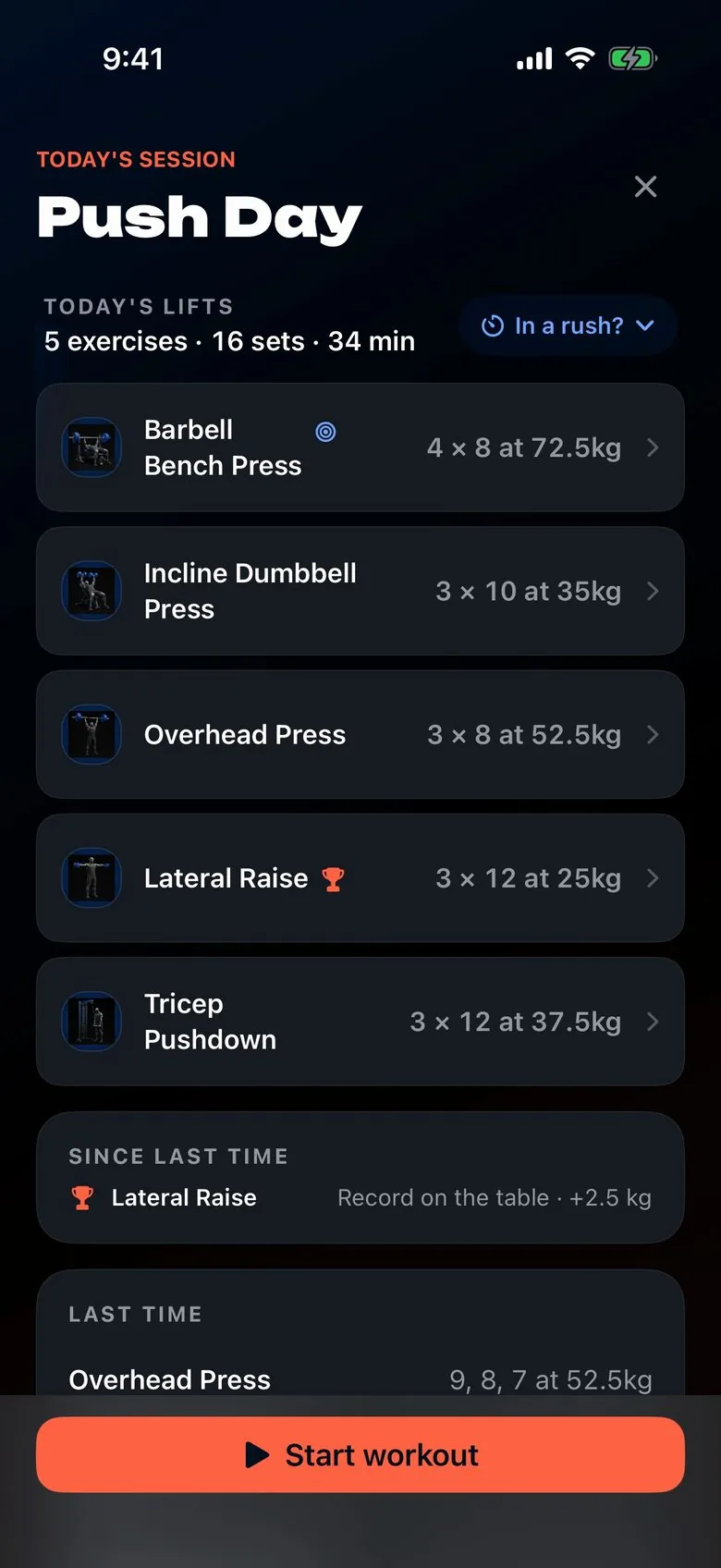
Plans your week.
Tell it your goal, your days and your gear. It builds the split, picks the lifts and sets every target.
Get the appHow the workout generator works
This is a rule-based workout generator, not AI. The same inputs always return the same plan. It selects an editorial split, matches exercises to your equipment, sets rep ranges from your goal, and fits working sets inside a transparent time budget. It does not use your training history or Trainer's adaptive coaching engine.
Two or three days use full-body sessions. Four use upper/lower. With weights, five use push/pull/legs plus upper/lower; six repeat push/pull/legs. No-equipment plans keep upper/lower at higher frequencies because floor drills cannot make a genuine loaded pull day. Unlisted weekdays are rest days.
Goal, experience, and exercise choices
Strength uses 5–8 reps on main movements with 150-second rests. Muscle uses 8–12 with 90-second rests. General fitness uses 10–15 with 60-second rests. Accessories generally use 10–15 reps and shorter rests; timed core holds are labeled separately. These are starting choices, not exclusive rep ranges for each outcome.
Beginners receive two working sets where time allows and simpler variations. Intermediate lifters receive three and different variations. Short sessions can contain single work sets. Preparation sets are separate. The American College of Sports Medicine's position stand, *Progression Models in Resistance Training for Healthy Adults*, provides general programming context; this exact algorithm is an editorial template, not an ACSM-validated program.
The session-time calculation
Estimated time equals preparation plus repetition time plus between-set rest plus transitions. The model allows three seconds per rep at the top of the range and counts both sides of unilateral work. It reserves five minutes for preparation, or seven in a gym, and one minute between exercises, or ninety seconds in a gym.
The generator first assigns three main movements, adds sets that fit, and includes optional movements only when time remains. It never shortens the prescribed rests to squeeze in another exercise. The estimate cannot predict queues or your warm-up needs. Longer preparation or rest means doing less work or allowing more time. A ninety-minute budget does not force ninety minutes of volume.
A worked example: three days, forty-five minutes
Choose muscle, beginner, three days, full gym, and forty-five minutes. Monday starts with goblet squats, machine chest presses, and seated cable rows. Romanian deadlifts, dead bugs, and shoulder presses follow when they fit. Wednesday changes the emphasis to a hinge and overhead press; Friday starts with single-leg work.
The main movements use 8–12 reps and ninety-second rests. Begin with a manageable load that leaves about three clean reps in reserve. If every working set reaches twelve with the same technique and reserve, add the smallest available increment next time. Reset toward eight reps and build again. A missed target means repeating or reducing the load.
Equipment limits matter
Dumbbell plans assume only a pair and floor space. Floor presses replace bench presses, and rows need no extra bench. Dumbbells provide loaded rows but no vertical pull here. Bodyweight plans require no furniture or bar, so prone upper-back drills appear with an explicit limitation: they do not replace progressive loaded pulling. Add suitable equipment when back-strength progression is the goal.
Use the warm-up calculator for an illustrative barbell ramp. Practice judging reserve with the RPE calculator. The progressive overload calculator shows a transparent rep-before-load scenario; none of these tools can observe technique or assess an injury.
Turn the template into a repeatable week
Choose a schedule you can repeat before adding visits. Beginners can start with two or three days; more sessions are an option, not a requirement. Keep notes on actual reps, loads, rest, and meaningful substitutions. Read the beginner full-body plan for context and the progressive overload guide for decisions after a difficult session.
This page provides a starting week. Trainer's coach adapts training week to week using the app's coaching flow. This generated plan does not automatically transfer to the app.
Frequently asked questions
Is this an AI workout generator?
No. It uses visible deterministic rules, so identical inputs produce identical plans. Trainer's in-app coach offers a separate adaptive coaching experience; this page does not call it or use your workout history.
Can I use it with no equipment?
Yes, with an important limit: floor-based upper-back drills are not loaded rows or pull-ups. The plan assumes no bar or furniture. Choose dumbbells or a gym for progressive loaded pulling.
Will every workout fill my time budget?
No. It fits work, rests, transitions, and a preparation allowance inside the budget. It does not add unnecessary volume to fill spare time. Extra preparation, equipment queues, or longer rest may extend the estimate.
When should I add weight?
Reach the top of the range on every working set with consistent technique and the stated reserve. Beginners require one successful exposure; intermediates require two consecutive exposures. Then add the smallest available increment. Repeat or reduce when targets are missed.
Keep building your plan
- Progressive Overload Calculator: Next Weight and Reps
- Warm-Up Sets Calculator – Ramp to Your Working Weight
- RPE Calculator & Chart – RPE/RIR to % of 1RM
- Workout Log Template: Printable and CSV Journal
- Beginner Workout Plan: 3-Day Full Body
- Progressive Overload: The Beginner's Guide
- Compare apps that track and progress your next set
- Choose a repeatable exercise and check the setup