
Progressive Overload Calculator: Next Weight and Reps
See an eight-week example that builds reps before adding weight. Every increase assumes successful working sets; repeat the target whenever those conditions are not met.
Your numbers, your next step.
Slide or enter a value to update the result.
Eight-week double-progression scenario
6–10reps
Each session assumes all working sets succeed with consistent form and at least 1–2 reps in reserve. If they do not, repeat the load and reps. No automatic increase is earned by the calendar.
| Week | Session targets |
|---|---|
| 1 | 60 kg × 6; 60 kg × 7 |
| 2 | 60 kg × 8; 60 kg × 9 |
| 3 | 60 kg × 10; 62.5 kg × 6 |
| 4 | 62.5 kg × 7; 62.5 kg × 8 |
| 5 | 62.5 kg × 9; 62.5 kg × 10 |
| 6 | 65 kg × 6; 65 kg × 7 |
| 7 | 65 kg × 8; 65 kg × 9 |
| 8 | 65 kg × 10; 67.5 kg × 6 |
Free, no signup. Inputs stay in your browser; they are not sent to Trainer.
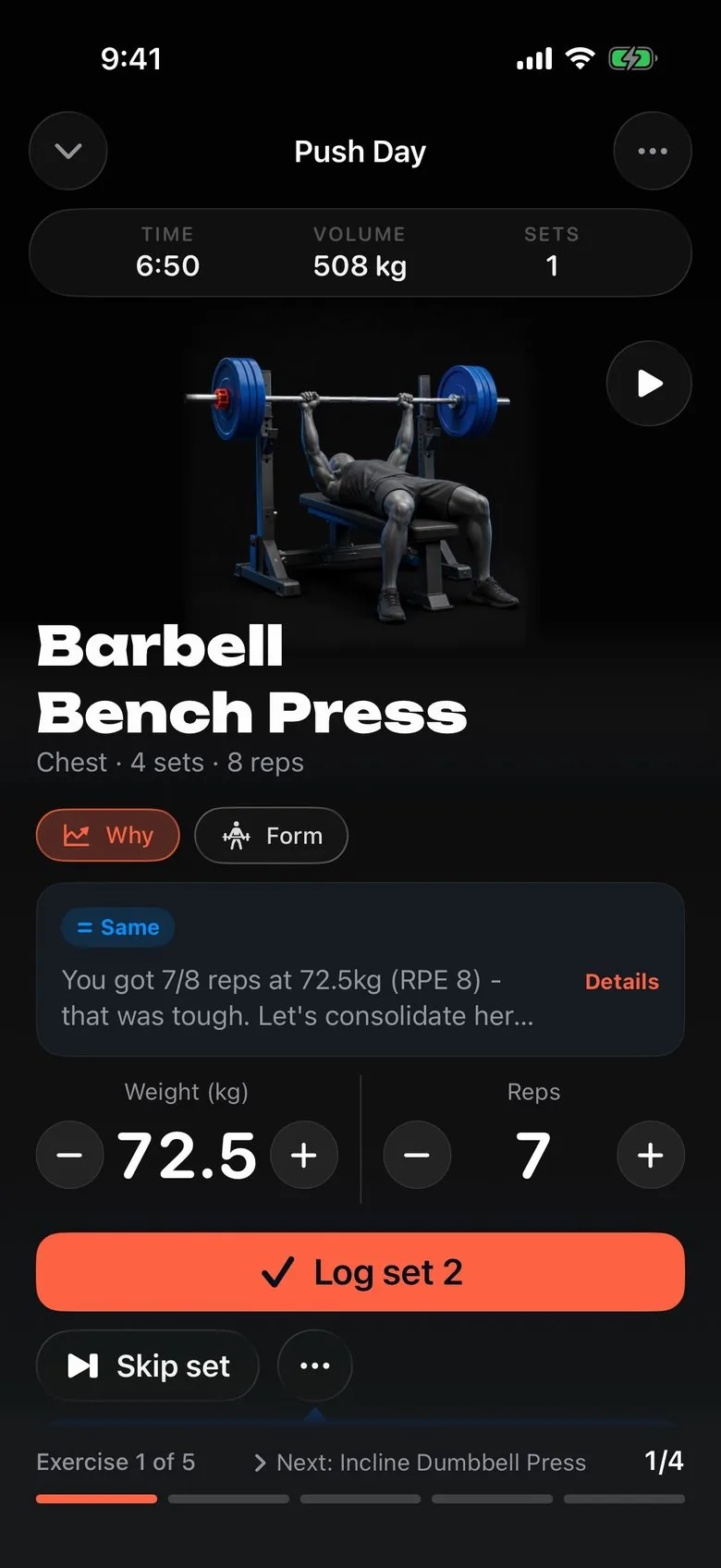
Calls your next set.
Every set arrives pre-filled with the weight and reps to hit next, and the reason why.
Get the appPlan progression without forcing it
Progressive overload means increasing a meaningful training demand over time as you adapt. It does not mean increasing every exercise's weight every week regardless of performance. This calculator shows one double-progression scenario: build repetitions inside a range, then add a small amount of load and return to the lower end.
Enter a starting weight, the total increase you can make, the minimum and maximum reps, and the number of weekly sessions for this specific lift. The output covers eight weeks of session targets. It assumes success at each listed session. That assumption makes the sequence easy to visualize, but it does not turn the calendar into permission to add weight.
The double-progression rule
The model starts at your minimum rep target. After a successful session, it adds one repetition to the next target. Once the maximum target is completed, it increases weight by your chosen increment and resets reps to the minimum. If the minimum and maximum are equal, every successful exposure earns the next load increase in this simplified scenario.
For a 60 kg start, a six-to-eight rep range, and two weekly exposures, the first targets are 60 × 6 and 60 × 7. The next exposure is 60 × 8. Only after that successful top-of-range performance does the example move to 62.5 × 6. You can change the fields to see how rep range and training frequency affect the sequence.
| Exposure | Example target | Next step after success |
|---|---|---|
| 1 | 60 kg × 6 | Add one rep |
| 2 | 60 kg × 7 | Add one rep |
| 3 | 60 kg × 8 | Add 2.5 kg total |
| 4 | 62.5 kg × 6 | Build reps again |
Define success before training
Apply the target to a consistent number of working sets with the same exercise technique and range of motion. A practical example is three sets, all reaching the target with at least one or two clean reps in reserve. If you planned three sets of eight and completed eight, seven, and six, you have not met that all-sets condition.
Repeat the target when it is not earned. You might improve total repetitions across sets before every set catches up. That is useful progress even if the calculator's hypothetical next row has a larger weight. The RPE calculator can help describe effort, but honest observation matters more than filling in a perfect number.
Choose a load increase your equipment supports
Enter the increment for the complete lift. On a barbell, two 1.25 kg change plates add 2.5 kg total. For an exercise logged per dumbbell, use the increase for one dumbbell and keep that convention consistent. Switching units converts the starting load and increment; it does not assume the new gym has matching equipment.
The plate calculator checks standard barbell combinations. If the next available dumbbell is a large jump, extending the rep range or repeating the load may be more workable than making an increase you cannot control. A larger step is not automatically better progression.
Account for fatigue and missed sessions
The scenario does not include illness, travel, poor sleep, pain, or changes to your other training. Those events can change the right next step. If a session is missed, resume from the last useful target rather than jumping to the weight shown for the current calendar week. If effort rises while reps decline repeatedly, review recovery and the training dose.
The guide to progressive overload explains how to recognize earned increases. The guide to deload weeks covers reducing demands when accumulated fatigue makes ordinary work unusually difficult. A deload is not a flaw in the chart; it is an adjustment to the real training process.
Use eight weeks as a planning window
Keep the same core movements long enough to compare sessions. Review actual completed sets, technique, effort, and attendance after the block. If the hypothetical sequence moved faster than you did, use your real log to revise the next block. The point is a clear progression rule you can execute, not a table of heavier numbers that you feel required to achieve.
Frequently asked questions
Do I add weight every week?
Only after your defined working sets reach the top of the rep range with consistent form and suitable effort. The table assumes every exposure succeeds; real sessions can repeat a target.
What if I miss a workout?
Resume from your last useful target. Do not jump ahead just because the calendar reached the next week in this illustrative scenario.
How many sets does the calculator assume?
It shows load and reps for an exposure. Choose a consistent working-set count; the guide uses three sets as an example. Earn increases only when all your chosen sets meet the condition.
Keep building your plan
- RPE Calculator & Chart – RPE/RIR to % of 1RM
- Plate Calculator – What Plates to Load on the Bar
- Calories Burned Lifting Weights Calculator: MET Estimate
- Workout Generator: Build a Weekly Lifting Plan
- Workout Log Template: Printable and CSV Journal
- Progressive Overload: The Beginner's Guide
- Deload Week: When and How to Deload
- Compare apps that track and progress your next set
- Choose a repeatable exercise and check the setup