
FFMI Calculator: Fat-Free Mass Index
Estimate fat-free mass index from your height, body weight, and body-fat estimate. See both raw FFMI and the historical height adjustment without inferring health or drug use.
Your numbers, your next step.
Slide or enter a value to update the result.
Fat-free mass index · estimate
19.75
Fat-free mass: 64 kg. Historical height-normalized FFMI: 19.75. Fat-free mass includes more than muscle. No steroid-use or health classification is inferred.
| Metric | Estimate |
|---|---|
| Raw FFMI | 19.75 |
| Height-normalized FFMI | 19.75 |
| Fat-free mass | 64 kg |
Free, no signup. Inputs stay in your browser; they are not sent to Trainer.
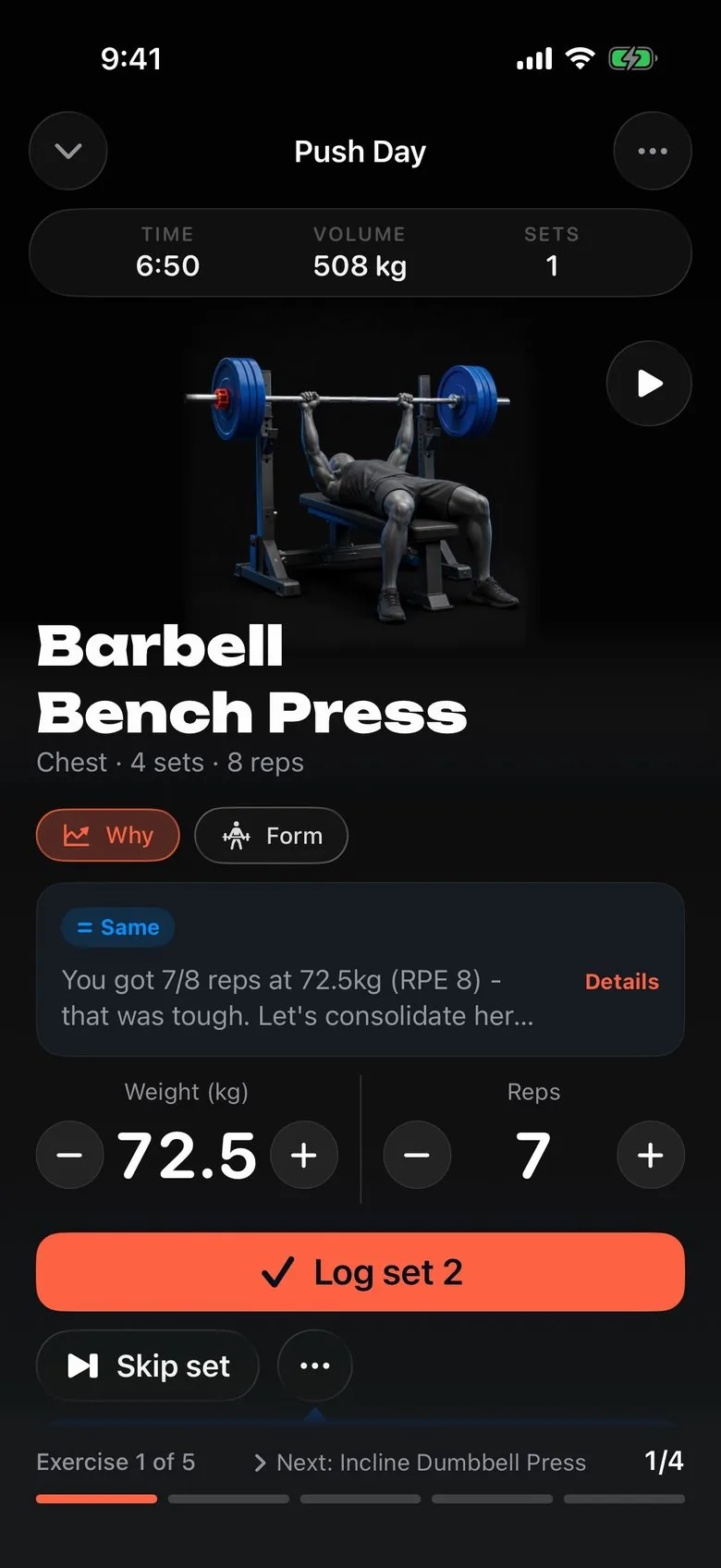
Calls your next set.
Every set arrives pre-filled with the weight and reps to hit next, and the reason why.
Get the appWhat FFMI estimates
Fat-free mass index relates estimated fat-free body mass to height. It is calculated from body weight and a body-fat estimate, so its accuracy depends on those inputs. Fat-free mass includes water, bone, organs, and other tissues as well as muscle. FFMI is not a direct measurement of muscle size.
Enter a representative weight, height, and your estimated body-fat percentage. The unit switch converts weight and length together. It does not change the percentage. Use a consistent measurement method when comparing observations, and keep the original inputs so you can tell what changed.
The FFMI formula
Fat-free mass equals weight in kg multiplied by one minus body-fat percentage divided by one hundred. Raw FFMI divides that mass by height in meters squared. For 80 kg at twenty percent estimated body fat, fat-free mass is 64 kg. At 1.80 m, raw FFMI is approximately 19.75.
This page also reports the historical height-normalized calculation: raw FFMI plus 6.3 multiplied by 1.80 minus height in meters. The adjustment comes from Kouri and colleagues' 1995 study. Its original context was male athletes, so do not treat the adjusted number as a universal biological standard for every person.
| Example inputs | Estimated fat-free mass | Raw FFMI |
|---|---|---|
| 80 kg, 180 cm, 20% body fat | 64 kg | 19.75 |
| 80 kg, 180 cm, 15% body fat | 68 kg | 20.99 |
| 70 kg, 170 cm, 20% body fat | 56 kg | 19.38 |
Why body-fat uncertainty matters
A different body-fat estimate changes the result even when scale weight and height stay fixed. In the first two examples, a five-percentage-point input difference changes estimated fat-free mass by four kilograms. That is arithmetic from an assumption, not proof that four kilograms of muscle appeared or disappeared.
The Navy body fat calculator provides a historical circumference estimate if you need one, but it also has limitations. Tape placement, tension, and normal variation can affect the inputs. Do not compare estimates from several methods as though they were interchangeable precise measurements.
Do not use FFMI as a steroid accusation
The historical study is often reduced online to a rigid natural-limit number. A small historical sample and uncertain individual body-fat estimates do not justify diagnosing someone's drug use from a calculator. This page deliberately does not label users natural, enhanced, healthy, or unhealthy.
A result outside an expected personal range should prompt a check of the inputs and their method. It is not proof of a medical condition or a reason to accuse another person. Use the metric only for the descriptive role the evidence supports.
Keep trends comparable
Use consistent weighing conditions and a consistent body-fat method. Daily changes in hydration and food can influence body weight and estimated fat-free mass. A small short-term index change is weak evidence of actual tissue change. Review a longer pattern with training performance and other appropriate observations.
The guide to body recomposition explains why simultaneous fat-loss and muscle-gain goals need more than a scale number. The guide to lean bulking explains controlled food adjustments without guaranteeing that every kilogram gained will be muscle.
Put the number beside a useful training record
Record familiar exercises, actual working loads, repetitions, and technique context. More controlled reps or steadier later sets can be meaningful progress even while an estimated body-composition index stays similar. FFMI should not replace the training evidence that guides the next session.
The protein calculator can help organize a practical meal pattern for healthy exercising adults. It does not require an FFMI classification before you can train or eat sensibly. Use the few measurements that clarify the goal instead of collecting a larger dashboard for its own sake.
Keep the conclusion proportionate
This calculator performs a transparent transformation of estimated inputs. It cannot measure muscle directly, assess readiness, diagnose health, or predict a future physique. Preserve the input uncertainty and interpret changes over an appropriate period. The useful outcome is clearer context for a sustainable plan, not a score that overrides performance, recovery, or wellbeing.
Frequently asked questions
Does FFMI measure only muscle?
No. Fat-free mass includes water, bone, organs, and other tissues as well as muscle. The calculation also depends on the accuracy of your body-fat estimate.
Does an FFMI above 25 prove steroid use?
No. This tool makes no drug-use classification. Historical research and uncertain individual inputs do not support making accusations from a single calculator result.
Why show two FFMI values?
Raw FFMI divides estimated fat-free mass by height squared. The second uses a historical height adjustment originally studied in male athletes, with that limitation stated.
Keep building your plan
- Navy Body Fat Calculator – Tape-Measure Method
- Protein Calculator – Grams per Day to Build Muscle
- Lean Body Mass Calculator: Boer, James and Hume
- Body Recomposition: How to Lose Fat and Build Muscle
- Lean Bulk: Calories, Macros and Rate of Gain
- Compare nutrition trackers for your calorie and protein plan
- Choose a repeatable exercise and check the setup