
Bench Press Calculator – Your Max and Strength Level
Calculate a bench max from a controlled hard set, then compare its bodyweight ratio with editorial landmarks. Start with useful evidence rather than a maximum attempt.
Your numbers, your next step.
Slide or enter a value to update the result.
Estimated bench press max · Epley
93.3kg
- Brzycki
- 90 kg
- Lombardi
- 94 kg
1.17× body weight · Novice (editorial estimate). Not a population percentile or a tested max.
Training loads from your estimate
Each row is a percentage of the Epley estimate.
| % estimated bench max | Share of your max | Total barbell load |
|---|---|---|
| 100% | 93.3 kg | |
| 95% | 88.7 kg | |
| 90% | 84 kg | |
| 85% | 79.3 kg | |
| 80% | 74.7 kg | |
| 75% | 70 kg | |
| 70% | 65.3 kg | |
| 65% | 60.7 kg | |
| 60% | 56 kg | |
| 50% | 46.7 kg |
Free, no signup. Inputs stay in your browser; they are not sent to Trainer.
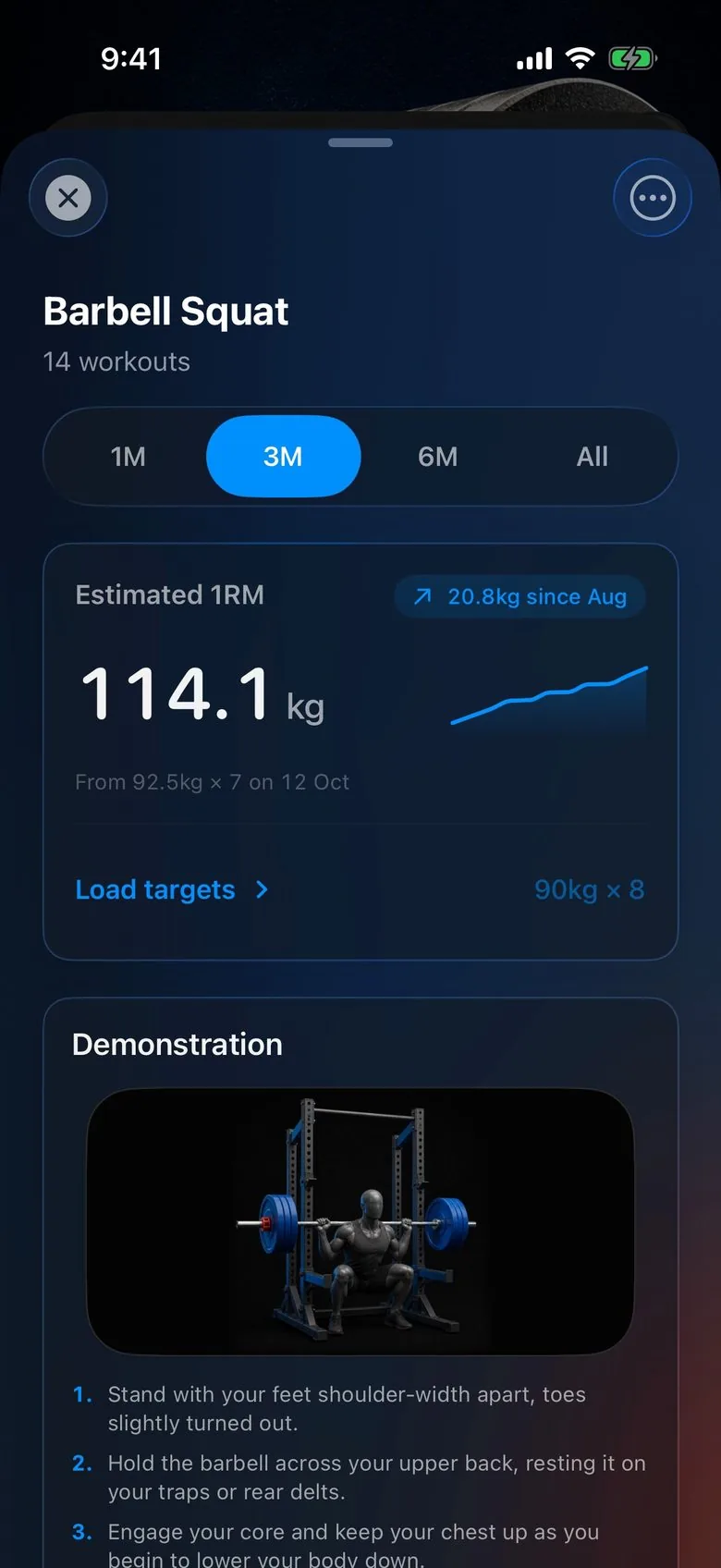
Every lift, tracked.
Trainer works out your estimated max from the sets you log, for every lift, and shows how far it has moved.
Get the appCalculate a bench max from a working set
Enter the total load on the bar, including the bar itself, and the number of completed repetitions. Add your body weight to get a lift-to-bodyweight ratio. The main result uses Epley, with Brzycki and Lombardi estimates alongside it. A controlled set near your limit is more informative than a comfortable warm-up.
Keep the bench standard clear. A paused rep, a controlled touch-and-go rep, and a bounced rep are different performances. Use a consistent setup and range of motion when comparing estimates over time. The calculator cannot observe those details, so your record needs to preserve them.
The bench calculator formula
Epley multiplies load by one plus reps divided by thirty. At 80 kg for five completed reps, that gives roughly 93.3 kg. Dividing that estimate by an 80 kg body weight gives about 1.17 times body weight. A single completed rep returns the actual load instead of inflating it; an easy single is still not proof of an absolute maximum.
The other formulas provide context about model disagreement. Brzycki gives 90 kg for the same set, while Lombardi gives about 94 kg. None is a personalized test. Use one model consistently for trends and keep the original load, reps, and effort information beside the prediction.
| Bench set | Epley e1RM | Ratio at 80 kg body weight |
|---|---|---|
| 60 kg × 5 | 70.0 kg | 0.88× |
| 80 kg × 5 | 93.3 kg | 1.17× |
| 80 kg × 8 | 101.3 kg | 1.27× |
What the strength level means
The displayed category uses Trainer's editorial bodyweight-ratio landmarks. It is an estimate for planning, not a percentile from a surveyed population or an official qualification. Selecting a reference group changes the illustrative thresholds; it does not assess every individual circumstance or prescribe a safe load.
For published community averages and bodyweight context, read average bench press standards. That page names the source and distinguishes its self-selected lifting community from the general population. Do not use a category to pressure yourself into an unready maximum attempt.
Use the percentage chart sensibly
Each row multiplies the Epley bench estimate by the listed percentage. It does not promise a particular rep count at that weight. Choose a load your plates can make and judge the first working set against the planned technique and effort. If readiness differs today, adjust rather than treating the chart as an obligation.
Use the plate calculator to load a balanced bar. If the exact target is impossible with standard plates, it reports a shortfall. Record the actual achieved load. The one-rep max calculator provides the same three models for other comparable lifts.
Work toward 225 without inventing a deadline
A 225 lb bench is about 102.1 kg, while 100 kg is about 220.5 lb. Keep the actual milestone clear. An estimated max above either figure is supporting information, not a verified lift or a reason to test without appropriate preparation, safeties, and spotting.
The guide to increasing your bench press gives an illustrative practice plan. It builds reps before load and keeps the standard stable. The progressive overload guide explains what to repeat when every working set has not reached the increase condition.
Compare actual sessions, not only the largest estimate
Later-set reps can improve while the first set and its estimate stay unchanged. Look at the whole working-set record. Note meaningful changes in rest, exercise order, or equipment. Several comparable sessions provide clearer evidence than one unusually flattering prediction.
A useful bench calculator reduces guesswork for the next training target. It cannot assess pain, readiness, rack safety, or the quality of a missed rep. Preserve the actual performance, choose a manageable next step, and let the estimate support that decision within its limits.
Frequently asked questions
Is this a tested bench maximum?
No. It estimates a maximum from a completed set. Appropriate readiness, technique, safeties, and spotting still govern any heavy attempt.
Is the strength category a percentile?
No. It uses editorial ratio landmarks. The separate average bench page cites community data and explains its population limits.
Does switching units change my physical inputs?
The toggle converts the loads and body weight with full calculation precision. Kilograms and pounds refer to the same entered measurements.