
Warm-Up Sets Calculator – Ramp to Your Working Weight
Get a simple ramp from the empty bar toward your working weight. Loads round down to your available total increment, and duplicate steps are removed.
Your numbers, your next step.
Slide or enter a value to update the result.
Suggested ramp-up sets
5warm-up sets
An example ramp, rounded down to the available total increment. Keep every warm-up easy; add movement preparation as needed.
| Set | Weight | Reps | Plates a side |
|---|---|---|---|
| 1 · empty bar | 20 kg | 8 | None |
| 2 | 40 kg | 5 | 10 |
| 3 | 60 kg | 3 | 20 |
| 4 | 75 kg | 2 | 25 + 2.5 |
| 5 | 85 kg | 1 | 25 + 5 + 2.5 |
Free, no signup. Inputs stay in your browser; they are not sent to Trainer.
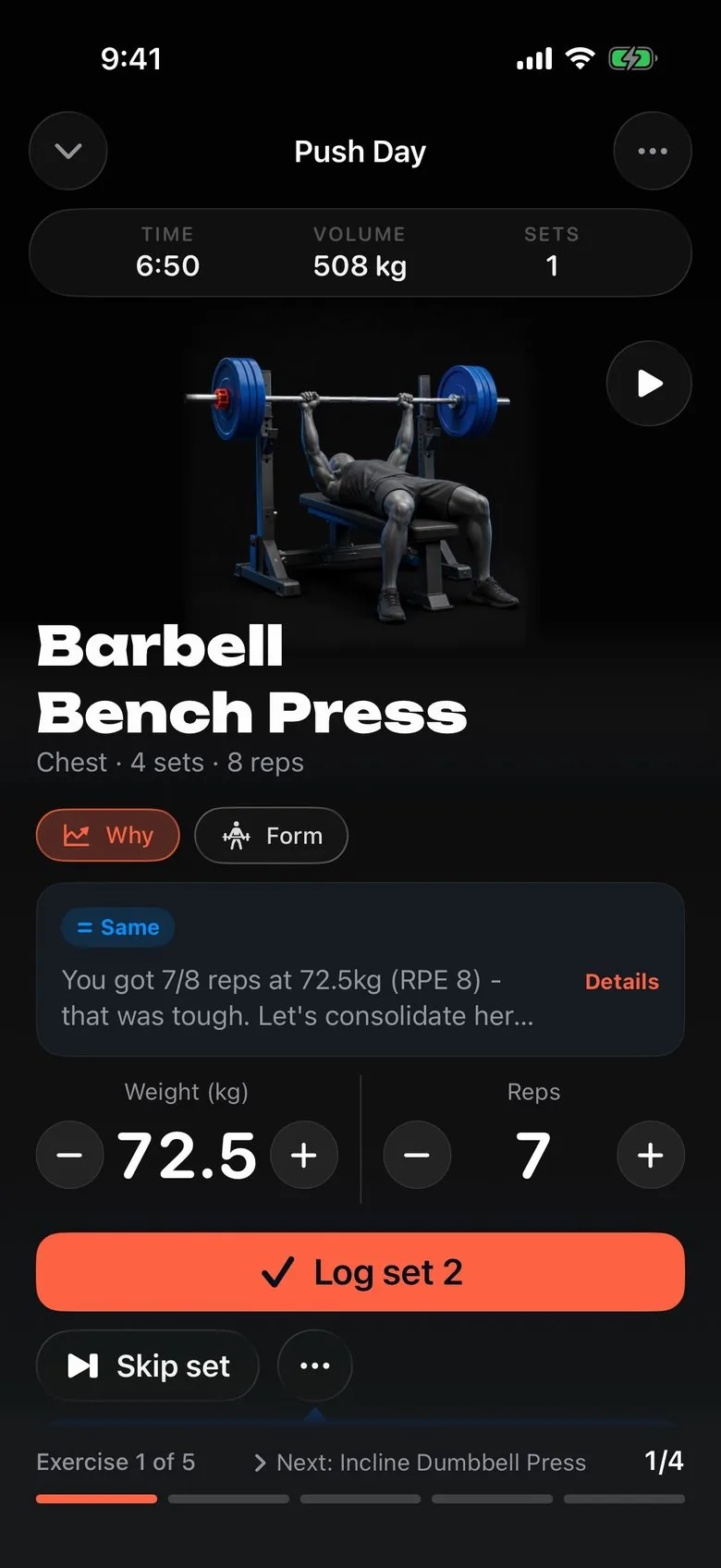
Calls your next set.
Every set arrives pre-filled with the weight and reps to hit next, and the reason why.
Get the appPrepare for the working weight without exhausting yourself
A useful warm-up helps you practice the movement and approach your planned working weight. It should leave you ready for the work, not use up the reps you wanted to perform later. Enter the complete working-set load, the bar weight, and the smallest total increase you can make with matching plates.
The tool starts with an empty-bar example, then offers steps near forty, sixty, seventy-five, and eighty-five percent of the working weight. Repetition counts decrease as load rises. This is one simple ramp, not a requirement that every lifter complete exactly five warm-up sets before every exercise.
The rounding formula
Each target is a percentage of your working load. To make it loadable, the calculator subtracts the bar weight, rounds the remaining plate load down to a multiple of your total increment, then adds the bar back. Loads never fall below the bar or reach the working-set weight in this example ramp.
For a 100 kg working load with a 20 kg bar and 2.5 kg total increments, the example starts at 20 kg, then moves through 40, 60, 75, and 85 kg. If the working load is close to the bar weight, some steps would be duplicates. The calculator removes those instead of asking you to repeat several identical warm-up loads.
| Example load | Example reps | Purpose |
|---|---|---|
| 20 kg bar | 8 | Rehearse the movement |
| 40 kg | 5 | Add manageable resistance |
| 60 kg | 3 | Approach working technique |
| 75 kg | 2 | Practice a heavier setup |
| 85 kg | 1 | Final easy ramp step |
Enter the increment for both sides together
A pair of 1.25 kg plates adds 2.5 kg to a barbell. A pair of 2.5 lb plates adds 5 lb. Enter that total increase, not the number printed on one plate. The rounding logic assumes each target can be built from the bar plus multiples of that increment; check your actual plate inventory before loading.
Use the plate calculator when you want a specific combination for each side. If your gym lacks a plate needed for a step, choose a nearby balanced load below the intended target. Do not let a small arithmetic difference make the warm-up complicated or turn it into an extra heavy set.
Adjust for the session you are actually doing
You may need more gradual steps before a heavy low-rep set than before a light accessory exercise. You may need less additional warm-up for a movement similar to the one you just trained. Consider temperature, time since your last session, familiarity, and how the first few reps feel.
General movement preparation can come before this ramp. The calculator does not prescribe cardio duration, stretching, rehabilitation, or a pain-management plan. If pain changes the movement, stop and address it rather than hoping that one more percentage step will fix the problem. Warm-up arithmetic cannot determine whether a lift is appropriate today.
Keep the early sets easy
The suggested reps are examples. If the empty bar is already demanding, reduce the reps or choose a lighter suitable option. If a listed warm-up starts to grind, reassess the planned working weight. The purpose is preparation. You do not earn a better workout by tiring yourself out before the actual sets begin.
The RPE calculator helps describe effort, but low-effort warm-ups are weak evidence for an estimated maximum. Save meaningful performance comparisons for working sets. The guide to increasing your squat explains consistent depth and setup; the guide to increasing your bench covers stable technique and suitable spotting.
Record the work separately from the preparation
Keep warm-ups distinct from hard working sets in your log. That makes weekly volume easier to review and prevents an apparent jump in training dose caused by adding extra preparation sets. Use this ramp as a starting checklist, observe your readiness, and adjust the final working load when the session gives you better information than the calculator had.
Frequently asked questions
Is this a personalized warm-up prescription?
No. It is an illustrative barbell ramp. Adjust it to the movement, working load, readiness, and your actual equipment while keeping preparation sets easy.
Why are some sets missing?
Steps that round to the same load, remain at the bar weight, or reach the working weight are omitted. A light working load does not need repeated duplicate steps.
What does total increment mean?
It is the smallest increase across both sides together. Two 1.25 kg plates add 2.5 kg total; two 2.5 lb plates add 5 lb total.
Keep building your plan
- Plate Calculator – What Plates to Load on the Bar
- RPE Calculator & Chart – RPE/RIR to % of 1RM
- Workout Generator: Build a Weekly Lifting Plan
- Progressive Overload: The Beginner's Guide
- How to Increase Your Bench Press (and Hit 225)
- Compare apps that track and progress your next set
- Choose a repeatable exercise and check the setup