
Lean Body Mass Calculator: Boer, James and Hume
Estimate lean body mass with the Boer, James, and Hume equations, then compare a method using your body-fat estimate. All four results describe estimated mass excluding fat, rather than measuring skeletal muscle or diagnosing health.
Your numbers, your next step.
Slide or enter a value to update the result.
Lean mass · from entered body fat
64kg
Includes water, organs, bone, and muscle. Compare the three historical height-and-weight formulas below; they are adult estimates, not measurements of skeletal muscle or a diagnosis. James is not shown above BMI 35. An invalid formula does not affect the other estimates.
| Method | Estimated lean mass |
|---|---|
| Boer (1984) | 61.4 kg |
| James (1976) | 62.7 kg |
| Hume (1966) | 57.8 kg |
| Entered body-fat percentage | 64 kg |
Free, no signup. Inputs stay in your browser; they are not sent to Trainer.
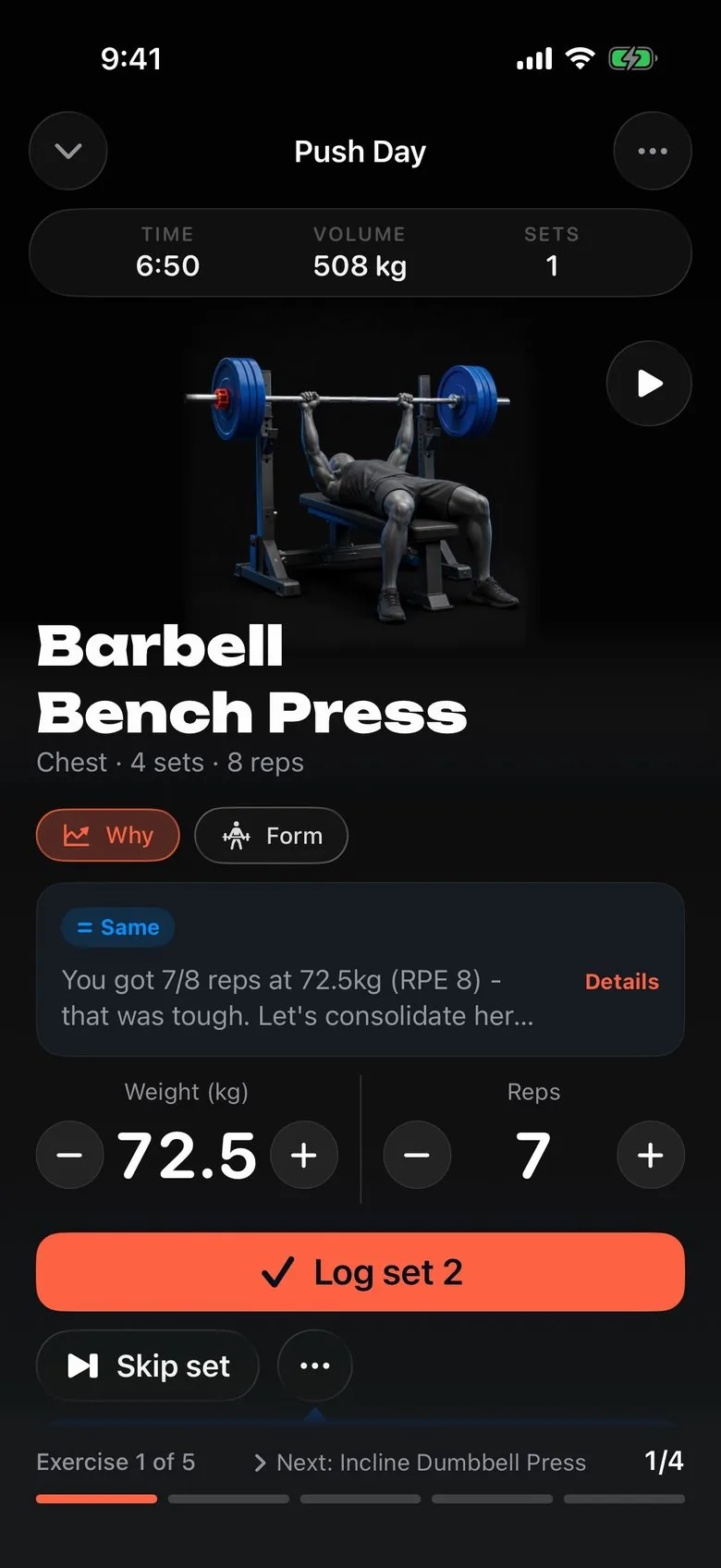
Calls your next set.
Every set arrives pre-filled with the weight and reps to hit next, and the reason why.
Get the appHow it works: four lean-mass estimates
This tool compares three historical adult equations with a calculation based on estimated body-fat percentage. Sources are Boer's 1984 paper, Estimated lean body mass as an index for normalization of body fluid volumes in humans; James's 1976 Research on Obesity report; and Hume's 1966 paper, Prediction of lean body mass from height and weight. Each height-weight equation uses its own sex-specific coefficients.
The results are estimates rather than a body-composition examination. The fourth method subtracts estimated fat mass from total body weight. It is commonly used as a fat-free-mass approximation; historical lean-body-mass terminology and measurement models are not perfectly interchangeable. None of these calculations isolates skeletal muscle.
Boer, James, and Hume formulas
In every equation below, W is body weight in kilograms and H is height in centimeters. Convert pounds and inches first. Parentheses matter in James: square the entire W/H ratio, rather than dividing weight by squared height.
| Method | Male coefficients | Female coefficients |
|---|---|---|
| Boer | 0.407W + 0.267H − 19.2 | 0.252W + 0.473H − 48.3 |
| James | 1.1W − 128(W/H)² | 1.07W − 148(W/H)² |
| Hume | 0.3281W + 0.33929H − 29.533 | 0.29569W + 0.41813H − 43.293 |
The body-fat method is W × (1 − body-fat percentage ÷ 100). Unlike the three historical equations, that arithmetic does not use height or sex coefficients. Changing the selected coefficient group therefore changes three results while leaving the body-fat result unchanged.
Worked example: 80 kg, 180 cm, 20% body fat
Using male coefficients, Boer gives 0.407 × 80 + 0.267 × 180 − 19.2 = 61.42 kg. James gives about 62.72 kg, and Hume gives about 57.79 kg. The body-fat method gives 80 × 0.80 = 64 kg. Those differences are model disagreement, rather than proof of four different tissue measurements.
For the same height and weight with female coefficients, Boer gives 57 kg, James gives about 56.37 kg, and Hume gives about 55.63 kg. The body-fat method still gives 64 kg. This comparison makes the historical assumptions visible; it does not determine which coefficient group accurately represents an individual.
Where the estimates become less useful
The original equations use simple height-weight relationships and binary coefficient groups. They do not directly observe age, training history, hydration, pregnancy, illness, or unusual body proportions. They are not designed to establish a child's body composition. A very muscular or high-body-weight adult can differ substantially from the populations behind a formula.
James includes a negative squared weight-height term, so its behavior can become implausible at high weight relative to height. Above BMI 35, its row shows “Not valid at this BMI” instead of a number. Any historical estimate at or below zero or at or above total body weight is also shown as invalid, while the other results remain available. These checks prevent nonphysical displays; they do not validate the remaining results for clinical use.
Keep body-fat uncertainty visible
At 80 kg, changing the body-fat input from 20% to 25% changes estimated fat-free mass from 64 to 60 kg. The four-kilogram difference follows from the assumption; it does not show that muscle was lost. The Navy body-fat calculator supplies another estimate, with tape-measure limitations of its own.
Use the FFMI calculator only if relating estimated fat-free mass to height serves your goal. For practical next steps, read body recomposition or lean-bulk calories, and use the protein calculator for a separate meal-planning reference. Record actual strength sessions in Trainer so performance, recovery, and consistent measurements can inform progression together.
Frequently asked questions
Is lean body mass the same as muscle mass?
No. These estimates include water, bone, organs, and other non-fat tissues as well as muscle. They cannot show how much skeletal muscle you have or whether a short-term change represents muscle growth.
Which estimate is the most accurate?
The calculator cannot identify the best equation for an individual. Boer, James, and Hume are historical population-based models. The fourth method depends on the accuracy of your body-fat estimate, which also has measurement error.
Why do male and female coefficients change the answer?
The original models use different coefficients for their male and female groups. Selecting a group changes those equations, not your inputs or the body-fat method. The binary models do not describe every person's body composition.
Why does the calculator reject some combinations?
A historical equation can return zero, a negative value, or lean mass equal to or above total weight at extreme height-weight combinations. Those nonphysical results are rejected. Valid-looking outputs can still be inaccurate outside the original study populations.
Keep building your plan
- Navy Body Fat Calculator – Tape-Measure Method
- FFMI Calculator: Fat-Free Mass Index
- Protein Calculator – Grams per Day to Build Muscle
- Body Recomposition: How to Lose Fat and Build Muscle
- Lean Bulk: Calories, Macros and Rate of Gain
- Compare nutrition trackers for your calorie and protein plan
- Choose a repeatable exercise and check the setup