
Lift Goal Calculator: How Long to Bench 225?
Enter a current lift, goal, and assumed weekly gain. Compare a steady scenario with one at half that rate; neither is a prediction or a promised deadline.
Your numbers, your next step.
Slide or enter a value to update the result.
Illustrative time to your goal
20–40weeks
Assumes average gains of 1 kg/week or half that rate. A scenario, not a forecast. Stalls and missed weeks extend the timeline.
| Week | At 1 kg/week | At half that rate |
|---|---|---|
| 4 | 84 kg | 82 kg |
| 8 | 88 kg | 84 kg |
| 12 | 92 kg | 86 kg |
| 16 | 96 kg | 88 kg |
| 20 | 100 kg | 90 kg |
| 24 | 100 kg | 92 kg |
| 28 | 100 kg | 94 kg |
| 32 | 100 kg | 96 kg |
| 36 | 100 kg | 98 kg |
| 40 | 100 kg | 100 kg |
Free, no signup. Inputs stay in your browser; they are not sent to Trainer.
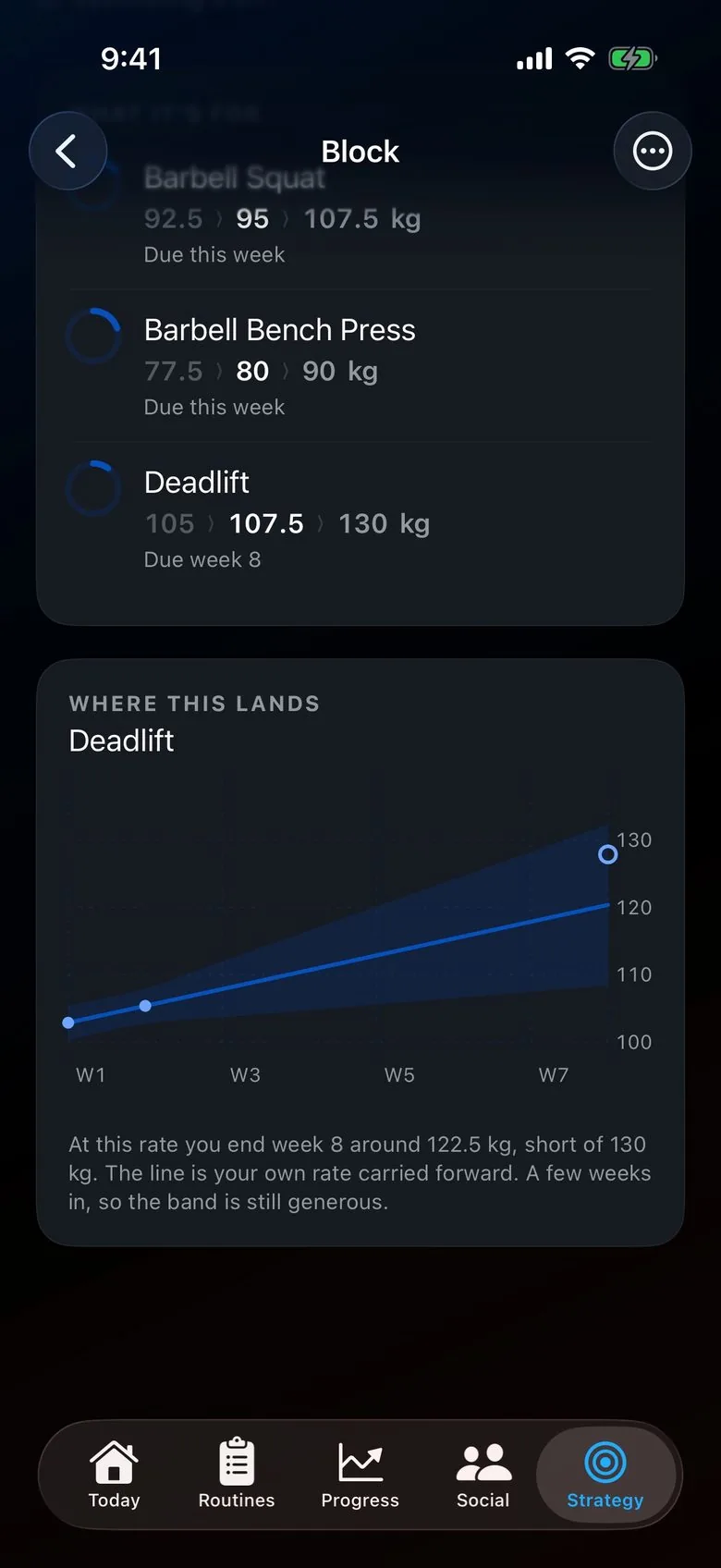
See the day you'll hit your goal.
Your lifts, plotted forward. See when 100 kg arrives, and what moves it closer.
Get the appWhen will I bench 100 kg or 225 lb?
A calculator cannot know that date from your current lift alone. It can show what different progress assumptions would imply. Enter a current tested or estimated maximum, a goal expressed in the same kind of performance, and an average weekly increase you want to explore. The result is an arithmetic scenario, not a promise that training will follow that line.
Also keep the units honest. A 100 kg bench is about 220.5 lb. A 225 lb bench is about 102.1 kg. Those are popular milestones in different plate systems, but they are not exactly the same load. Switch units to convert your inputs rather than treating the labels as interchangeable. The actual plate combination will decide what you can load in your gym.
The timeline formula
The faster scenario divides the gap between current and goal by the weekly gain you enter, then rounds up to a whole week. The slower scenario repeats the calculation using half that gain. If the current lift equals or exceeds the target, the tool reports that the goal is already met rather than displaying a negative timeline.
For an 80 kg current lift and a 100 kg target, the gap is 20 kg. At an assumed 1 kg per week, the arithmetic is twenty weeks. At half that rate, it is forty weeks. Neither line includes a guarantee about technique adaptation, recovery, missed sessions, or how progress changes as you get stronger.
| Assumed average gain | 20 kg gap | Interpretation |
|---|---|---|
| 2 kg/week | 10 weeks | Faster scenario |
| 1 kg/week | 20 weeks | Middle arithmetic example |
| 0.5 kg/week | 40 weeks | Slower scenario |
Compare like with like
A goal for one repetition should use a current single or a comparable estimated maximum. Do not subtract an 80 kg ten-rep set directly from a 100 kg single goal and call the difference your strength gap. Use the one-rep max calculator if you want a rough bridge between a hard working set and a single-repetition target.
Keep technique stable too. A shallow squat and a consistent-depth squat are different performances. A bounced bench is different from a controlled rep. If the goal includes a pause, a depth standard, or a specific piece of equipment, write that into the goal before measuring progress. A milestone only helps when you know what completing it means.
Choose an assumption from recent training
Look at several comparable sessions before choosing a rate. If you recently added reps rather than weight, do not pretend that every week produced a fixed increase in maximum strength. Estimates can help summarize the trend, but they remain estimates. A modest assumption is more useful for planning than the fastest number the input field accepts.
Linear gains rarely continue indefinitely. Early improvements can include learning the movement and getting more comfortable with effort. Later progress may require a different rep range, smaller increments, more consistent practice, or better recovery. The guide to increasing your bench press explains those decisions in concrete terms.
Turn a distant goal into a near-term action
Pick something you can do in the next session: complete a target rep range with consistent form, use a smaller load jump, or add a second well-recovered practice session. The progressive overload calculator shows an eight-week example using double progression. Its increases are conditional on successful sets, not on the arrival of a new week.
The guide to breaking a strength plateau helps when the recent trend stops. Repeating a load while improving control can be productive. The timeline is not a reason to force a heavy attempt on an arbitrary date.
Review the goal as evidence changes
Revisit the assumption after a meaningful block of training. If progress is slower, adjust the scenario and examine the program rather than interpreting the estimate as a missed promise. If progress is faster, celebrate the actual sets and keep the next increase sensible. The useful part of a goal calculator is seeing how assumptions affect a plan while leaving room for the person who must perform the training.
Frequently asked questions
Does this predict my goal date?
No. It divides the gap by the rate you choose and compares a slower scenario. It does not model your physiology, adherence, injuries, or future plateaus.
Are 100 kg and 225 lb the same milestone?
No. 100 kg is about 220.5 lb, while 225 lb is about 102.1 kg. The toggle converts inputs so you can keep the actual goal clear.
What if I already lift the goal weight?
The result reports that the goal is met when the current comparable lift is equal to or above the target. Make sure both inputs refer to the same rep and technique standard.
Keep building your plan
- 1 Rep Max Calculator – One Rep Max Calculator & Chart
- Progressive Overload Calculator: Next Weight and Reps
- Workout Generator: Build a Weekly Lifting Plan
- How to Increase Your Bench Press (and Hit 225)
- Progressive Overload: The Beginner's Guide
- Compare apps that track and progress your next set
- Choose a repeatable exercise and check the setup