
How to Do a Push-Up: Form and Your First Rep
To do a push-up, place your hands under or just outside your shoulders, brace your trunk, and keep a straight line from head to heels. Lower your chest toward a fist-height target with elbows angled back, then press to straight arms. If you cannot keep that shape on the floor, begin with your hands on a stable raised surface.
In this guide
How do you do a push-up with good form?
- Set your hands under or just outside your shoulders. Spread your fingers and press through your whole hand. Put your feet far enough back that your head, hips, and heels make one line.
- Tighten your stomach and glutes before bending your arms. Keep that tension as you move. Your hips should travel with your chest, not arrive first or lag behind.
- Bend your elbows about 30–45 degrees away from your body. Think of pointing them partly back, rather than straight out to the sides. Keep your gaze on the floor slightly ahead of your hands.
- Lower your chest toward a fist-height target on the floor. Use the same target on each rep. If you cannot reach it without losing your body line, use a higher hand position.
- Press the floor away until your elbows straighten. Finish with your body still rigid. That is one rep; a half-depth lower or a bent-arm finish does not count toward your progression target.
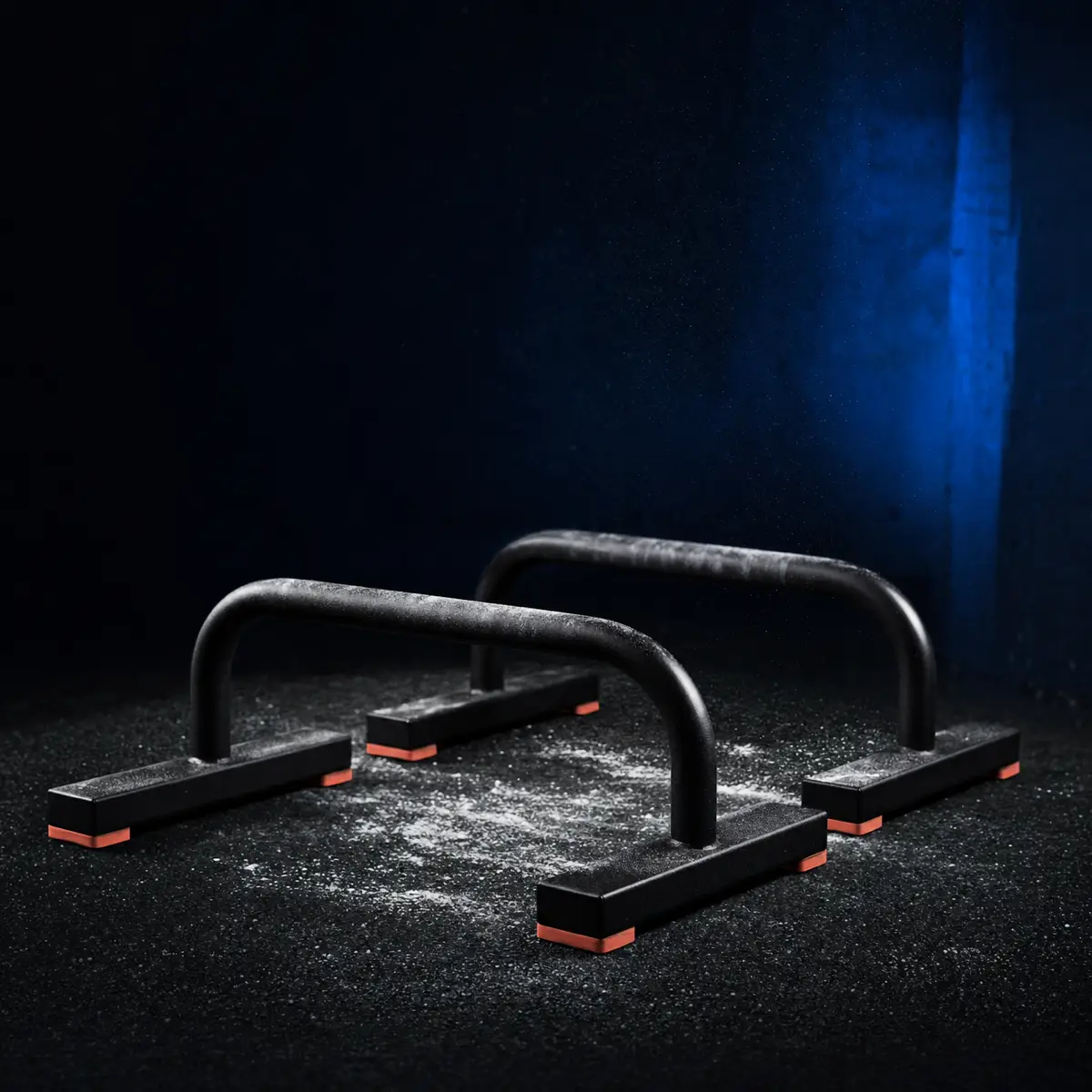
Pause at the top before the next rep. Breathe in on the way down and out as you press. Avoid dropping into the bottom position. If flat palms hurt your wrists, fists or push-up handles can keep your wrists straight. The push-up exercise page shows the movement steps.
Why can't I do a push-up yet?
A floor push-up asks your arms and trunk to move your body together through a full range. Watch where the rep breaks, then choose the matching practice:
- Pressing strength relative to body weight: Your body stays straight, but your arms cannot press you up. Raise your hands to a height where you can finish full reps, then work down the ladder.
- Trunk stiffness: Your hips sag or rise ahead of your chest. Brace your stomach and glutes before each rep, and practise holding a straight line at a higher incline.
- Bottom-range position: You can press from the top but stall near the fist-height target or cut the descent short. Use a higher incline for full-depth reps; after those sets, try controlled lowers only while you can keep your body line.
How do you test where to start?
Choose three stable hand positions: a wall, a high counter or fixed rail, and a lower sturdy bench or fixed rail. Check that each surface stays still when you lean your weight into it. Keep your shoes on the floor, hands at about shoulder width, and the same chest-to-surface depth at every height. Do not use a rolling chair or a loose table.
At each height, do as many controlled reps as you can. Stop at the first rep that shortens, twists, or loses the head-to-heel line. Rest about two minutes before trying the next, lower height. Skip a floor test if the low incline already breaks your shape.
Pick the lowest position where you can do at least five good reps. If you manage four clean reps at a low rail but eight at a high counter, train at the high counter. If you manage fewer than five at the wall, step closer to it and retest. Record the surface, hand height if practical, and clean rep count.
Keep the chosen height for the first session. Let repeated sets decide when it changes.
What is the push-up ladder?
Use the same setup for every working set. A workable start is three sets of five to eight reps, resting about two minutes between sets. Stop each set with the last clean rep; never add a bent or shortened rep just to reach eight. If you cannot reach five on all three sets, raise the hands or reduce the target to a level you can repeat.
| Rung | Hand position | Session target | Move on when |
|---|---|---|---|
| Wall | Hands on a wall; step feet back for a full body line | 3 sets of 5–8 | All 3 sets reach 8 clean reps in 2 sessions |
| High incline | Hands on a stable counter or fixed high rail | 3 sets of 5–8 | All 3 sets reach 8 clean reps in 2 sessions |
| Low incline | Hands on a stable bench or fixed low rail | 3 sets of 5–8 | All 3 sets reach 8 clean reps in 2 sessions |
| Floor | Hands on the floor; chest to a fist-height target | 3 sets of 5–8, or clean singles while building toward 5 | All 3 sets reach 8 clean reps in 2 sessions before choosing a harder variation |
The exit rule applies to every set, not the best one. If you get 8, 8, and 6, stay at that height. On the next visit, try to bring the third set closer to eight while preserving depth. Once you get 8, 8, and 8 on two separate sessions, lower your hands one rung. Expect the reps to return toward five. That is a normal change in difficulty, not lost progress.
If the jump from a low bench to the floor is too large, use a secure rail or step between them. Keep the same exit rule. The incline push-up exercise page shows the body line.
Are incline or knee push-ups better for beginners?
Ebben and colleagues found that hands-elevated and knee push-ups load less than floor push-ups, while feet-elevated push-ups load more. That comparison does not tell you which height you personally need.
An incline lets you adjust difficulty in small steps while keeping the floor rep's head-to-heel shape. Knee push-ups can still let you practise the press if no safe incline is available. Keep a straight line from head to knees and record them as a separate variation.
For a first floor rep, make the incline your main exercise. You can use knee push-ups afterward if they feel comfortable.
Do push-ups build strength and muscle?
Kikuchi and Nakazato found that, over eight weeks at two sessions a week, push-ups adjusted to the same load as a 40% 1RM bench press matched that bench press for strength and chest and triceps thickness gains. Calatayud and colleagues found that, over five weeks, banded 6RM push-ups matched 6RM bench press strength gains in trained students.
Once floor reps are easy, keep the work hard by moving to harder variations rather than adding endless reps.
What should you do for four weeks?
Train on three nonconsecutive days each week, such as Monday, Wednesday, and Friday. ACSM's resistance-training position stand includes two to three days a week for novices and gradual progression. The sets and reps below are a coaching starting point, not a result proven by that paper.
| Week | Each of the three sessions | End-of-week decision |
|---|---|---|
| 1 | At your tested rung, do 3 sets of 5 clean reps; rest about 2 minutes | If all sets are clean, aim for 6 per set next week; otherwise keep 5 or raise the hands |
| 2 | Do 3 sets of 5–8, adding a rep to a set only when depth and body line hold | If all 3 sets reach 8 for 2 sessions, lower the hands one rung; otherwise stay |
| 3 | Do 3 sets of 5–8 at the rung earned by your log | If a lower rung drops below 5 clean reps per set, return to the previous height |
| 4 | Do 3 sets of 5–8; after the last session, try 1 floor rep only if low-incline sets reached 8 twice | Keep building at your current height if the floor rep bends, sags, or stops short |
The exit rule outranks the calendar. If you complete a rung early, move down on the next session and start near five reps. If you miss a session, resume at your last successful height; do not double the next session.
If the first set looks worse than usual, do fewer clean reps or raise the hands one step. If all three sets fall below five, use the easier height next time.
If your low-incline sets met the exit rule by the end of week four, warm up with easy incline reps, then try one floor rep toward a fist-height marker. Count it only if your hips and chest rise together to straight arms. Otherwise, continue the three-session pattern and retest after another week or two. The calisthenics hub places this pressing progression beside pulling, leg, and core skills.
Can negatives and top holds help?
Use these after your main incline sets, not in place of them. For a negative, start at the top of a floor push-up and lower in about three seconds while keeping your body rigid. Put your knees down to return to the start; do not force an ascent you cannot control. Try two sets of two lowers, with a full rest between sets. Stop the negative when your hips drop or your shoulders collapse.
For a top hold, straighten your arms at the floor or your current incline and hold a firm line for ten to twenty seconds. Try two holds after the main sets. If your trunk gives way, use a higher incline.
Choose the negative if the descent is your missing skill; choose the hold if your body line fails first. Skip both if your working sets leave you too tired to stay in position.
Which common mistakes should you fix first?
- Hips sag: Raise your hands and brace your stomach and glutes before the first rep. If the line breaks after rep four, count four and stop that set.
- Elbows flare straight out: Move your hands under or just outside the shoulders and aim the elbows partly back. Do not force them against your ribs; find a comfortable angle near 30–45 degrees.
- Half reps: Pick a visible chest target and use it on every rep. Raise the hands until you can reach that depth without dropping or bouncing.
- Head pokes forward: Look at the floor rather than the wall ahead. Keep your neck in line with your back as your chest approaches the target.
- Hips rise first: Push the surface away while keeping your ribs and pelvis together. If the press still turns into a pike, use a higher incline.
Fix one fault at a time. A side view can show whether the last counted rep matched the first in depth, line, and finish.
When should you stop a set or a session?
Stop a set when you cannot keep the body line, reach the same depth, or straighten your arms without twisting. Shaking or muscle effort alone can be normal; a sharp pain in the wrist, elbow, or shoulder is different. Stop the session for that pain. Do not try to push through it to meet a number in the table.
If a hand position causes joint discomfort, check the surface and your hand placement. Use an easier angle only if it is comfortable. If sharp pain persists, see a physiotherapist or doctor before you train it again.
How do you track the next step?
Record the surface or height, each set's clean reps, and one short note about depth or body line. A line such as “high rail: 8, 8, 7; last rep shallow” tells you to repeat the rail. “High rail: 8, 8, 8” twice with full depth tells you to try the lower rail.
Logging is free in Trainer. For bodyweight moves, it suggests the next harder version after every working set reaches the top of the rep range for two sessions in a row without a grind. Its push-up ladder runs incline push-up → push-up → close-grip push-up → feet-elevated push-up → single-arm push-up. Use your recorded form and the two-session rule to decide whether the next version is ready.
If your goal later changes from one clean rep to more floor reps, use how to do more push-ups after you have a repeatable baseline.
Sources
- Ebben et al., 2011. Kinetic analysis of several variations of push-ups. J Strength Cond Res
- ACSM, 2009. Progression models in resistance training for healthy adults. Med Sci Sports Exerc
- Kikuchi and Nakazato, 2017. Low-load bench press and push-up induce similar muscle hypertrophy and strength gain. J Exerc Sci Fit
- Calatayud et al., 2015. Bench press and push-up at comparable levels of muscle activity results in similar strength gains. J Strength Cond Res
Frequently asked questions
How many push-ups should a beginner do?
Start with three sets of five controlled reps at a hand height that lets you finish every set. Work toward eight per set. Lower your hands only after all three sets reach eight with good form in two sessions.
Are knee push-ups worth doing?
Yes, if they let you practise a comfortable, full-range press. Keep a straight line from head to knees and log them separately. An adjustable incline is usually more useful when your aim is to keep the head-to-heel position of a floor push-up.
How long does it take to do your first push-up?
There is no dependable four-week promise. Test your starting height, train three nonconsecutive days a week, and move down only after two sessions of clean sets at the top of your range. Retest one floor rep when low-incline work is solid.
Should your elbows flare out during a push-up?
Let them point partly back, about 30–45 degrees from your body. Straight-out elbows often come with a wide hand position and a shortened rep. Choose a comfortable hand position and keep your depth consistent.
Do push-ups build muscle?
They can provide useful pressing work when the variation is challenging and you progress it over time. For your first rep, focus on controlled full-range practice. Once floor reps are repeatable, adjust reps or variation to keep the work appropriately hard.
Try the numbers for yourself.
Your next working set
Decide when to add reps, increase load, or repeat the weight.
Workout log template
Fill in your sets, download a CSV, or print a log for the gym.
A useful next read.
All guidesHow to Do More Push-Ups: From 5 to 20 Reps
Weekly plans for 5, 10, 15 and 20 reps, with regular retests.
Three full-body sessions a week for 12 weeks, with a level for every exercise.