
How to Do Dips: Form, Depth and Progressions
To do a dip, hold yourself up on parallel bars with straight arms and your shoulders pressed down, away from your ears. Lean your torso slightly forward, bend your elbows, and lower until your upper arms are about parallel to the floor, or to the depth your shoulders accept comfortably. Press back to straight arms. If you cannot do one yet, start with support holds and assisted dips.
In this guide
How do you do a dip?
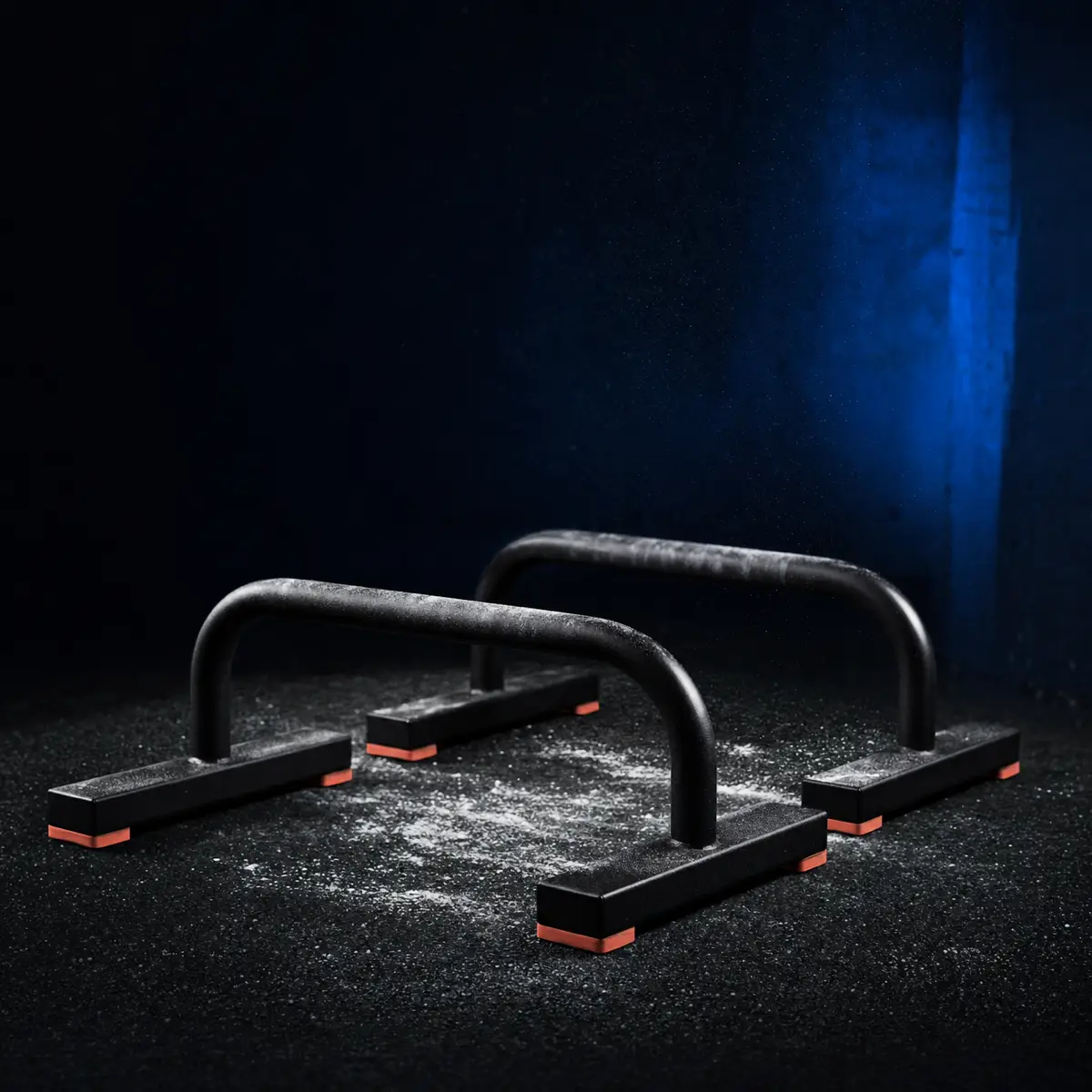
- Use stable parallel bars about shoulder width apart or a little wider. Grip with your palms facing in and your thumbs wrapped around the bars.
- Jump or step up to a straight-arm support. Your hands sit beside your hips, your elbows are locked, and your shoulders press down, away from your ears.
- Bend your knees and cross your ankles, or keep your legs straight and slightly in front of you.
- Lean your torso slightly forward and bend your elbows. Let them travel back, not out to the sides, as you lower under control.
- Stop at your working depth. For many people that is the upper arm about parallel to the floor, with the shoulder roughly level with the elbow.
- Press the bars down until your elbows are straight again. Finish tall, with your shoulders still down, before you start the next rep.
Take about two seconds to lower. Breathe in on the way down and out as you press. A rep counts only when it reaches your chosen depth and returns to straight arms. The dips exercise page has a short step list and the muscles involved.
How deep should you go on dips?
Your shoulders set the depth, not a rule. Upper arms about parallel to the floor is a common target. Some people go a little lower with no trouble; others feel a pinch at the front of the shoulder before they reach parallel.
Deeper is not automatically better. Going lower takes your shoulder further into extension, with the upper arm reaching behind your body, while it carries almost your whole body weight. Extra range is worth training only when you can control it without discomfort.
Find your depth with a slow test. From the support position, lower over about three seconds. Stop at the first sign of any of these: a pinch or ache at the front of the shoulder, your shoulders rolling forward, or your shoulders shrugging up toward your ears. Press back up. Your working depth sits just above that point.
Use the same depth for every counted rep; a side-view video shows it. If today's depth is above parallel, that is your standard for now. Add range slowly over weeks, and only while it stays comfortable.
Chest dips vs triceps dips: what changes?
Both versions train your chest, triceps and the front of your shoulders. Your torso angle changes how the work is shared.
- Chest emphasis: lean your torso well forward, let your legs sit slightly behind you, and let your elbows drift a little out from your sides. Bars slightly wider than your shoulders often suit this version.
- Triceps emphasis: keep your torso more upright, with your legs under you or slightly in front, and point your elbows straight back. Bars about shoulder width suit this version.
Pick one style for an exercise and keep it, so your reps compare from session to session. Avoid very wide bars for either style; they put the shoulders in a position many people find uncomfortable. If arm strength is your main goal, the triceps exercise directory lists movements to pair with dips.
Where should you start?
Test on stable bars. Hold a straight-arm support for up to 30 seconds with your shoulders down. Rest about two minutes, then do as many full reps as you can at your working depth before your depth or lockout changes.
- Support hold under 30 seconds: start with support holds.
- 30-second hold but no full rep: start with band- or foot-assisted bar dips, or with bench dips if you have no bars.
- One to four full dips: start with negatives.
- Five or more full dips: start with full dips.
If the support hold is hard and push-ups are also a struggle, build your pressing with how to do more push-ups alongside the hold.
What is the dip ladder?
Rest about two minutes between sets. Move up only after every set meets the exit rule in two separate sessions. A result of 10, 9, 7 on full dips means stay and try to bring the last set up. Expect fewer reps on each new rung; that is normal.
| Rung | Session target | Move on when |
|---|---|---|
| Straight-arm support hold | 3–4 holds of 10–30 seconds, shoulders down | All holds reach 30 seconds in 2 sessions |
| Feet-assisted bench dip (optional) | 3 sets of 8–12 to a comfortable depth, knees bent | All 3 sets reach 12 in 2 sessions with no front-of-shoulder discomfort |
| Band- or foot-assisted bar dip | 3 sets of 5–8 with the same assistance | All 3 sets reach 8 in 2 sessions; then reduce the help |
| Negative dip | 3–5 lowers of 3–5 seconds each to your working depth | 5 controlled lowers in 2 sessions |
| Full bar dip | 3 sets of 5–10 | All 3 sets reach 10 in 2 sessions |
| Ring support hold | 3 holds of 10–30 seconds with the rings steady | All holds reach 30 seconds in 2 sessions |
| Ring dip | 3 sets of 3–8 | All 3 sets reach 8 in 2 sessions |
| Weighted dip | 3 sets of 5–8 with a small added load | All 3 sets reach 8 in 2 sessions; then add a little weight |
Support hold. Lock your elbows, press your shoulders down and keep your body still. This straight-arm support is also the starting position of an L-sit.
Assisted dips. Loop a band securely across the bars and kneel on it, or rest your feet on a box placed under you so your legs give only the help you need. Keep the same band or foot position for the set. Before each set, check the band for nicks and make sure it cannot slide along the bars.
Negatives. Step up to the top from a box, lower over three to five seconds to your working depth, then step down and reset. Stop when you can no longer slow the descent. Three to five lowers is enough; they are tiring, and soreness can spoil your next session.
Full dips. If a set drops below five, finish with a few assisted reps rather than shorter ones.
Rings. Rings move in every direction, so start with the support hold, with the rings low enough that your feet can reach the floor or a box. Keep the rings close to your hips, arms straight, and turn them slightly out if that steadies them. In a ring dip, the rings brush your sides at the bottom. Expect far fewer reps than on bars at first. Solid bar and ring dips come before the muscle-up, which finishes with a press from a deep dip position.
Weighted dips. Use a dip belt or a firmly packed backpack. Start with a load that puts you at the bottom of the rep range, and add small amounts only after the exit rule passes.
How often should you train dips?
Two or three nonconsecutive days a week suits most people. ACSM's position stand on resistance-training progression describes progressive overload as a core principle and two to three training days a week for novices. The sets and reps in the ladder are coaching starting points, not numbers from that paper. In the calisthenics hub, dips sit with push-ups and handstands as pushing skills.
| Week | Each of 2–3 sessions | Decision |
|---|---|---|
| 1 | Run the test, then 3 sets at the low end of your rung's target | Record the bars, your depth and any assistance |
| 2 | Add a rep or a few seconds to any set where depth and lockout hold | Move up only if every set met the exit rule in 2 sessions |
| 3 | Train the rung your log has earned | If a new rung drops below its range, go back one |
| 4 | Same as week 3; in the last session, repeat the starting test first, while fresh | Start the next four weeks at the rung your log has earned |
How can you do dips at home?
Equipment built for dips is the safest choice: a dip station, dip bars on a rack, or parallel bars rated for your weight. Without one, check either of these options before you lift your feet.
A kitchen counter corner. Stand in an L-shaped corner and put one hand on each edge. Bend your knees so your feet stay clear of the floor at the bottom, and dip between the counters. Use it only if both edges are solid and fixed, with nothing loose on the surface.
Two sturdy chairs. This is the least stable option. Place heavy, non-folding chairs with their backrests facing each other, about shoulder width apart, on a floor where they cannot slide, and grip the top of each backrest. With your feet still down, press your full weight into them and feel for any rocking. During the set, push straight down; a sideways push can tip a chair. Never use folding, rolling or light plastic chairs.
If anything shifts, wobbles or creaks, stop and use a fixed bench for bench dips instead.
Are bench dips useful or risky?
Bench dips need only a bench or a sturdy step. Sit on the edge with your hands beside your hips, fingers forward. Walk your feet out with your knees bent and slide your hips off. Bend your elbows to lower your hips straight down, close to the bench, then press back up. The bench dips exercise page shows the setup.
The trade-off is the shoulder position. Your hands are behind you, so the shoulder works in extension under load, and at the bottom most people's shoulders roll forward. Many people do them without trouble; for others this is where the front of the shoulder complains.
Keep the range comfortable, often a little above upper arms parallel. Keep your chest up, your shoulders back and your hips close to the bench. Bent knees make them easier; straighter legs make them harder. When they get easy, move to assisted bar dips rather than raising your feet or piling weight on your lap. Skip bench dips if the front of your shoulder hurts during or after them; they are an optional rung, not a requirement.
What common dip mistakes should you fix?
- Shrugging: your shoulders creep toward your ears as you lower. Reset the support at the top of each rep, and end the set when you cannot keep them down.
- Going too deep: your shoulders roll forward or pinch at the bottom. Raise your depth target to just above that point.
- Elbows flaring wide: point them back, and narrow the bars if your setup allows it.
- Soft lockout: your arms stay bent at the top. Press to straight elbows on every rep; a bent-arm finish does not count.
- Swinging or kicking: settle your legs before each rep. Use more assistance if you need a kick to get moving.
- Dropping into the bottom: take about two seconds down. A fast drop loads the shoulder at the point you control least.
When should you stop a set of dips?
End the set when your depth, lockout or shoulder position changes. Hard work in your chest and triceps is expected. Pain at the front of the shoulder is not: stop the session if you feel it, or any sharp pain in your shoulder, elbow or wrist. Next time, try a shorter range or an easier rung only if it feels comfortable. If the pain returns each session or lingers, stop dips and see a physiotherapist or doctor.
How do you track dips in Trainer?
Logging is free in Trainer, and every set arrives pre-filled with the reps to hit next. If push-ups share your pressing days, its push-up ladder runs incline push-up → push-up → close-grip push-up → feet-elevated push-up → single-arm push-up, and it suggests the next harder version when every working set reaches the top of the rep range for two sessions in a row without a grind. For dips, use the exit rules in the ladder above to choose your next rung.
Sources
Frequently asked questions
Are dips bad for your shoulders?
Not for everyone, but depth matters. Dips load the shoulder in extension, so lower only to the point you control without a pinch at the front, keep your shoulders down, and stop for front-of-shoulder pain. If dips keep bothering you, push-up variations train similar muscles in a position many people find easier on the shoulder.
What muscles do dips work?
Dips mainly work your chest, triceps and the front of your shoulders, while the muscles around your shoulder blades hold you steady in support. Leaning forward shifts more of the work toward your chest; staying upright shifts more toward your triceps.
How many dips should I do?
Do three sets at your rung of the ladder, resting about two minutes, on two or three nonconsecutive days a week. On full dips, work in the range of five to ten reps. Once all three sets reach ten clean reps in two sessions, add reps for endurance or move to ring dips or added weight for strength.
Are bench dips as good as parallel-bar dips?
They are a different, easier exercise. Your feet take some of the load and you need only a bench, but your hands sit behind you, which puts the shoulder in loaded extension. Parallel-bar dips let you press your whole body weight and later add weight. Skip them if the front of your shoulder hurts.
Try the numbers for yourself.
Your next working set
Decide when to add reps, increase load, or repeat the weight.
Workout log template
Fill in your sets, download a CSV, or print a log for the gym.
A useful next read.
All guides
How to Do a Muscle-Up: Bar and Ring Progressions
The prerequisites, the bar progression and the ring version, step by step.
How to Do More Push-Ups: From 5 to 20 Reps
Weekly plans for 5, 10, 15 and 20 reps, with regular retests.